Showing posts with label tom defalco. Show all posts

Thursday, September 11, 2025

The Immortal Thorsday Thoughts 05

Last time on The Immortal Thorsday Thoughts: Dig into it and there is actually very little in common between the two [versions of the Thor Corps] [...] Why reuse the name at all? Aside from the commonality of a collection of Thors (and the presence of Beta Ray Bill), the original Thor Corps and this version are practically opposites on every level. Why would Thor specifically call the group that name? And, now, the continuation...

In Thor Corps #4, the main antagonist, Demonstaff, is defeated not through the strength of two Mjolnirs, a Stormbreaker, and a Thunderstrike, but through regaining his lost humanity. Demonstaff was a scientist whose obsession nearly drove his wife away prior to an accident that transformed him into a being of dimensional energy that he tried to shape and cage to look human. The thrust of the story is him trying to destroy all alternate realities into a single version, while also taking revenge on his wife, who he thought caused the accident. He’s finally defeated when, first Dargo Ktor, the future Thor, resists every temptation Demonstaff can put in front of him in order to get his own wife back from the villain and, then, Demonstaff’s wife goes to him and gets him to both believe that she never did anything to harm him, and to finally see that this path was his own making. He ultimately regains his humanity and the two are sent to a limbo-esque dimension as punishment for his crimes (she willingly goes with him). Basically, the Thor Corps wins through love and empathy and just giving a shit about others.

And how exactly does Thor defeat Toranos in The Immortal Thor #5? He makes him feel love and empathy and give a shit about others.

Beyond its echo back into a previous version of the Thor Corps, Al Ewing isn’t exactly original in this approach, one that we’ve seen at least twice this century and, oddly, both drawn by Frank Quitely: The Authority #20 written by Mark Millar where an evil version of the Doctor is defeated when the full extent of those powers kick in, including global overwhelming empathy for all; and All-Star Superman #12 written by Grant Morrison where Lex Luthor, having stolen Superman’s powers, is defeated when the full extent of those powers kick in, including global overwhelming empathy for all. I’m sure there are other notable examples and I don’t raise them to criticise Ewing for being unoriginal, more to acknowledge their existence as well-known comics that Ewing and many readers no doubt have knowledge of.

While they clearly weigh as influences to the scene where Toranos experiences the caring that comes as part of Thor’s power, particularly the horror that comes with it as an experience so foreign and different, forever altering his very being, the idea that Thor’s plan always rested upon a feign of strength being the path to victory when it’s really love truly does echo the way that the Thor Corps mini-series plays out. A story seemingly about a group of Thors coming together to travel across time and save all of reality through hammers and muscles and lightning... yet, the solution is genuine human caring. There, it was a trick played on readers by the creators of the series; here, it’s a trick played by Thor on Toranos.

The epigraph that Ewing uses for this issue is a clever foreshadowing of what happens to Toranos, one that he doesn’t telegraph by presenting it in Latin rather than English. Coming from the Carmina Burana, it’s fairly well known in Latin when set to music, so it’s not quite so unusual to present it that way. Set next to the quotes from the Poetic Edda, though, which are always translated into English (and so are any future epigraphs from sources not originally in English), it’s a purposeful choice. In a work about language, the meaning of words, and translation, this is the one quote presented where the reader needs to work to understand it on even the most basic level. Once translated, the meaning and connection to the issue is immediately clear, but so are other epigraphs. My best guess is that it’s meant to echo the experience of Toranos holding Mjolnir and receiving the power of Thor in full. At first, it’s impossible for him to understand who Thor is and what his true power is; but, once it’s ‘translated’ for him, it’s so obvious and overwhelming in its true meaning.

The translated epigraph (taken from here):

The wheel of fortune turns;

And I descend, debased;

Another rises in turn;

Raised too high

The king sits at the top

Let him fear ruin!

It seems almost pointless to actually analyse/discuss that epigraph given how literally you can apply it to Toranos (who holds the wheel), Thor (who lowers himself by giving his power away), and the result of Toranos gaining Thor’s power only for it to cause him to flee in horror. There’s also the opposite meaning, that the wheel turns, Toranos falls, Thor rises higher and must fear his future death (as sensed/seen by Jane Foster near the end of the issue). Or, to take it further, it’s the cycle that Gaea begins to plan in the short sequence at the beginning of the issue. Endless rise and fall, endless renewal, the wheel turns.

The revelation that Gaea is the one that set the Utgardians loose is shocking, yet telegraphed at the beginning of the issue. The idea that she would attempt to create a break in the war of the Ur-gods by introducing something new, thus spawning, eventually, the various pantheons, each with their peak, each variations on one another. The caption “A wheel that turned... yet, with each turning made new,” also relates to the manner in which Toranos is bested by Thor. They are both storm gods, Thor meant to be ‘weaker’ than Toranos in raw power, yet Thor has a strength that Toranos lacks: restraint. The judicious use of his power. While set upon Earth by Gaea, there’s also a sense that Toranos would simply do this anyway. He only knows destruction under the punishment of the superstorm. When the wheel turned enough times to produce Thor, while there is overlap with the elder god, there’s enough new to be foreign.

Which returns us to the Thor Corps and the way that this new version is a reversal/variation. As I said last week, the original iteration gathered twice and, each time, took on a threat from the future that threatened all reality, backwards through time. Toranos is literally the oldest (ish) sort of threat from the past, come to threaten the future, merging the two once he gains hold of Mjolnir, as he notes, “THE ANCIENT STORM MEETS WITH THE NEW! THE PAST AND THE FUTURE ARE ONE IN ME!” However, the past is quickly swept over by the future with modern ideas and considerations basically unstoppable. The wheel turns and, if this weren’t a Marvel comic, you can picture a world where the epigraph was simpler, taken from Deadwood:

“You cannot fuck the future, sir. The future fucks you.”

*

Essential Read Number One: Avengers Inc. #3

As we progress through the course of The Immortal Thor, I will sometimes have to flag so-called ‘essential’ comics that fall outside of the 25 issues of the monthly serial. Full disclosure: none are actually essential. You can read The Immortal Thor #1-25 from beginning to end without going outside of those issues and never fail to understand what’s going on. But, sometimes, Al Ewing wrote other comics that are as close to ‘essential’ as you can get without actually, you know, being that. Many will bear the name Thor on their cover, but not this one. Avengers Inc. #3 provides the answer to the unsaid question at the end of The Immortal Thor #5: how is Skurge alive and in Dario Agger’s office with Amora? Isn’t he meant to be dead?

Well, funnily enough, the issue begins with Skurge in Valhalla... dying. His own axe, the Bloodaxe, somehow flies at him and kills him. This is a seemingly impossible sort of murder given that Valhalla is full of the honoured dead and how can someone who is already dead die again? Jane Foster, in her role as the new Valkyrie, enlists Janet Van Dyne and Victor Shade to come to Valhalla and solve the mystery. In the course of their investigation, they figure out that the only way for Skurge to have died was with his own permission as a ruse to help him escape Valhalla and return to a mortal life. And only someone with an intricate knowledge of Valhalla and the rules governing it, including ways to leave it, could have assisted. Namely, another resident, Odin. He reveals that Skurge had had visions of Thor’s death and sought to return to Earth to take that death again, even if it meant never returning to Valhalla.

All of this is eventually revealed in the pages of The Immortal Thor, so this issue acts as a bit of a revelation sooner than you’d get otherwise. As such, I do wonder if it’s best read around this point in The Immortal Thor or left until after issue 21 when the story is retold (minus the mystery elements). There’s something to be said about leaving the mystery in the pages of the main story where Skurge’s references to Thor’s death and trying to take it on behalf of the Thunder God as he did the first time he died, and it’s not made completely explicit what happened until the fight outside the gates of Utgard. It adds a bit of edge to Skurge’s actions with Amora and Dario Agger, I find.

Yet, I can’t pretend that I didn’t read this issue around this point of The Immortal Thor as it came out. It came out October 23, 2023, while issue four of The Immortal Thor came out November 15. So, it pre-dated this two-issue Thor Corps story, making it known fairly early in the run. That means Skurge showing up at the end of issue five isn’t a complete shock for those of us who read Avengers Inc. #3. We knew Skurge was back and would run into Thor at some point. I wouldn’t say that that diminished the reading experience any... and yet...

This is the sort of debate I have with myself at times when constructing reading orders where the spine is set and you need to decide where best to place ancillary issues. While the original release date meant that you could read it at X, does it maybe work better narratively at Y? When I did my Brian Michael Bendis-focused reading order for Secret Invasion, I very much ignored release order in favour of what I thought was the optimal reading experience. In the case of Avengers Inc. #3, I remain somewhat undecided. It’s clearly a direct tie-in to The Immortal Thor with the way it gives even Leonard Kirk the chance to draw the flash-forward image of Thor bloody with Mjolnir and Tormod in hand, ready to fight and die. It’s hard to ignore it.

Its placement here, after issue five, seems as good as any place. It doesn’t disrupt the flow from issue-to-issue, which it would a bit more following issue three, which ends on the tease of Thor going to meet Storm. And it follows up on that final page reveal where Skurge is there with Amora. The idea that Skurge returns from the dead due to a prophetic dream, in an effort to stave off that future, also ties in nicely with some of the ideas discussed above about the confrontation between Thor and Toranos. Skurge is rushing from the past toward a future, doing his best to change it, to overcome it... but, as we’ll see, it’s not possible. For the second time:

“You cannot fuck the future, sir. The future fucks you.”

Next week, The Immortal Thor #6, which shows how you can change the past, if you want, along with Thor #159, the first big retcon in Thor’s history.

Thursday, September 04, 2025

The Immortal Thorsday Thoughts 04

Ah, the Thor Corps. I was actually a little surprised when they brought back that name in The Immortal Thor #4 after it was passed over during Secret Wars when the Thor­-replacement series was titled Thors instead, despite featuring a group called the Thor Corps and the habit of reusing old titles for those series. I figured that there had to be a reason why they wouldn’t call the comic “Thor Corps” and use the original mini’s logo like the rest of the Battleworld minis during that event. It’s always baffled me and the inclusion of the name again here in The Immortal Thor only adds to that bafflement. Although, they don’t use the original logo in this issue when Thor says the name and it gets a logo-esque treatment (nor on the cover of issue 5). A little respect and homage paid, not in full, alas.

Prior to The Immortal Thor #4 and Thors, the Thor Corps originally appeared in Thor #438-441 and Thor Corps #1-4 by Tom DeFalco, Ron Frenz, and Patrick Olliffe (DeFalco and Frenz co-plotted the issues of Thor with DeFalco scripting and Frenz pencilling, while DeFalco wrote and Olliffe pencilled the followup mini-series). The first story where the group came together was actually titled “The Thor War” and had Zarrko the Tomorrow Man pit then-current Thor Eric Masterson again possible-future Thor Dargo Ktor to fuel his efforts to conquer time. The battle of two wielders of Mjolnir summoned Beta Ray Bill and, soon, the trio were teaming up to stop Zarrko, which meant fighting through an army of Thor enemies plucked from various points in time until they finally managed to win. Thor Corps reunited the trio, though Eric Masterson had given up Mjolnir for Thunderstrike by that point, trying to stop all of time and realities from being destroyed by Dargo’s enemy Demonstaff. At the end of the third issue, they use the collective power of Mjolnir, Thunderstrike, and Stormbreaker to summon Thor to aid them in their fight. Basically, the idea is exactly what it sounds like: multiple Thors (of sorts) teaming up.

What I’ve found interesting, in retrospect, is that Thor Odinson was barely involved. The first iteration of the group was during the period where the Odinson was thought dead and Eric Masterson wielded Mjolnir (and was still somewhat of a novice at it). The core trio of the Thor Corps was Masterson, Dargo Ktor, and Beta Ray Bill, who, as the most experienced hammer-user and warrior, settled into the role of leader (and peacemaker for the other two). While Masterson took the spotlight as far as perspective in the initial series since he was the star of Thor, the group was a bit of a Bill showcase. In both iterations, he was the calm, collected veteran Thor who could keep his head and come up with a plan of attack. In the first story, he became an example for Eric to follow as he learned how to be Thor – and, in the second, he was already established with the other two as the clear best Thor of the trio. One of my favourite moments is when Bill first arrives and Masterson is immediately awed, thinking “HE’S SO ALIEN--! AND YET, NOBILITY CLINGS TO HIM LIKE A SECOND SKIN! / HE REMINDS ME SO MUCH OF THE ORIGINAL THOR!

In the final issue of Thor Corps, the Odinson is seen as a bit of a last resort for the group, calling upon the ‘real’ Thor. Yet, despite his central role that places him above the others to an extent, much of his purpose is to give the other three moral support and inspiration. He doesn’t show up and take the attitude that they should fall in line behind him. He talks them up, treats them as equal, and takes the attitude that, if they’re all worthy, then they’re all worthy. There’s no worthier. There’s a trust among those that can lift Mjolnir. It’s that idea that carries over the most to The Immortal Thor #4 where Thor gathers together various trusted allies who’ve all held Mjolnir at some point (Beta Ray Bill, Storm, Jane Foster, and Loki) to stand against Toranos in a plan that requires absolute faith in each of their abilities to work together. The composition of the group is quite different from the original version(s) where Thor Odinson the All-Father is clearly the Thor in charge and he’s assisted by a group of veterans.

Save one.

The recruitment of Storm is the focus of the issue and her position in the group stands out, as she was not an experienced wielder of Mjolnir. (You can also question Loki’s time holding the hammer, but, as an Asgardian, he kind of gets a pass. Actually, as a side note to this side note: Loki is the final Thor villain that Zarrko plucks from the timestream and much of his fight with the Thor Corps has him absolutely bodying Eric and Dargo. It’s a rare instance where Loki’s enhanced Asgardian strength and warrior upbringing are given the spotlight to see him out-fight opponents, not just trick them or rely on magic.) Yet, her experience as an X-Man and her mutant powers give her a certain prestige. The confrontation between her and Thor as Thor interrupts her involvement in the war on Arakko is one that establishes her, at first, as Thor’s equal or better. Al Ewing relies on some very specific wording to seemingly give Storm the (temporary) edge by emphasising that she controls the weather while Thor only commands the storm (ironic given her name). It’s a clever bit of parsing of their particular skills, following up on a similar instance in the first issue where Thor commands a blizzard (a snow storm). So, while she’s a novice Thor, she brings her own formidable power to the table. In fact, every member of this iteration has their own abilities/powers outside of those bestowed by Mjolnir. It’s a bit of Thor Corps Supergroup version, you could argue.

The makeup of the group, both in members and conception isn’t the only change. Unlike the threats of Zarrko or Demonstaff, Toranos is not from the future. While he poses a threat to the future of the world or, as the holder of the Wheel, represents the idea of a future threat coming to pass, he’s more a relic of the past. As we’ll see in the next issue, the idea isn’t to defeat him either, but to change an old idea into something newer. The triumph of this Thor Corps is a triumph of the future over the past, a reversal of the previous version.

Dig into it and there is actually very little in common between the two (another change: the original all had their respective hammers, while this one shares a single Mjolnir). Why reuse the name at all? Aside from the commonality of a collection of Thors (and the presence of Beta Ray Bill), the original Thor Corps and this version are practically opposites on every level. Why would Thor specifically call the group that name?

That answer comes next week as I discuss The Immortal Thor #5 and the first comic that I’d call an essential read outside of the 25 issues of The Immortal Thor, Avengers Inc. #3.

Saturday, December 23, 2023

Merry Christmas, Eric Masterson!

You may find it hard to believe, but Thor #444 is the only Christmas issue of the title’s 60-plus years. Maybe I missed another issue or two with a reference to Christmas, this is the only issue that you could say, beginning to end, is pure holiday schmaltz. I don’t think that it’s a coincidence that it came during Eric Masterson’s time as the Thunder God while the Odinson was exiled beyond the known universe by acting All-Father Heimdall for killing Loki. An Asgardian and a Christmas issue don’t exactly mix given the North American view of the holiday and its origins. Taking a regular guy who happens to gain the powers of god when he taps a cane on the ground and putting him smack dab in the middle of a good ol’ fashioned holiday depression, though? That’s classic bordering on cliché.

“How the Groonk Stole Christmas!” lives for the holiday cliché. Tom DeFalco and Ron Frenz, well into their creative partnership, manage to take a fairly regular issue of their Thor run and deck it out with as many Christmas clichés and references as they can manage. From the titular Groonk being a friendly allusion to the Grinch, from his green appearance and Santa suit to his dog Max with one antler to a little girl named Cindy Lou that sticks up for him. Beyond that, there’s every holiday movie about a parent feeling estranged from their kid, or down on his luck due to money issues, or feeling like a worthless human. DeFalco and Frenz rip off the classics from A Christmas Carol to It’s a Wonderful Life. And, surprisingly, it works.

What could be eye-rolling never quite crosses the line because, firstly, DeFalco and Frenz are pretty clear that they know how cheesy and sappy this comic is. Every reference comes with a little wink that lets you know that they’re in on it too. Mostly, it’s that those elements are flourishes added here and there to what could be a non-Christmas issue of Thor. The entire issue is rooted in the ongoing struggles of Eric Masterson with the holidays acting as a focal point to magnify some of them. That root in Eric and his problems carries the issue past the Christmas clichés and actually lets a few of them land. By focusing on the genuine goodness of that character as he struggles to get through the day, DeFalco and Frenz transform Christmas clichés into a moving finale that feels earned – and welcomed.

The issue opens on Eric having spent nearly five hundred dollars on a gift for his son. Broke, about to lose his apartment due to superhero-related destruction, his architect career barely hanging on, and the general feeling that he’s a failure as Thor, the first page and a half is one long self-pitying monologue over a dozen or so thought bubbles. When a fellow shopper is robbed of only one of her many presents, the superhero plot of the issue is introduced. Apparently, there is a mugger who has been stealing a single present from people, seemingly at random (the people and the present). It seems like a simple criminal to take down and one that Eric feels good about trying to stop. There’s a sense that, if he’s able to catch this thief and return the stolen presents, he’ll have done something good at the holidays. He never says it outright, but the alluded outcome is that he’ll be saving Christmas, in a sense.

The visit with his son, Kevin, does little to lift his spirits. Despite giving him a much-desired gift that he can barely afford, Eric feels like a letdown to Kevin. His ex-wife is married to a professional football player and Eric feels like he can’t measure up to the lifestyle that they’re providing for Kevin. Even though his relationship with his ex and her husband is amicable, especially since he willing gave up custody of Kevin (to spare him the fallout of his double life as Thor), the strains of his superhero alter ego and the time away from his son turn it into a competition in his mind. He readily acknowledges that the expensive gift is an effort to ‘bride’ Kevin into overlooking his failings as a father and he’s so wrapped up in those feelings of inadequacy that he blows off Marcy’s invitation for him to join them for dinner and spend more time with Kevin.

His self-sabotage and desire to prove himself is a recurring feature in the issue, especially when he finally confronts the robber. It turns out to be a giant, hulking green monster in a Santa outfit that only yells the word “Groonk!” Their battle takes them into a shopping mall and Eric’s need to take down this seeming monster causes him to go all out and not do the best job at keeping the innocent people around them safe. At one point, he ducks an eye blast from the Groonk before realising that it was meant for a beam that, now broken, allows part of the ceiling to fall in. When the battle leads into the sewers, Eric almost fights against a group of homeless people living there until a little girl, Cindy Lou, intervenes and explains the situation. The Groonk is normally a gentle creature that, inspired by a story about Christmas, has been stealing presents to give everyone living in the sewer a proper Christmas. As I said, it’s a little cloying except for the way that it works against your typical superhero story.

Captain America would later chastise Eric for his handling of the situation: Eric takes back the stolen gifts, but doesn’t turn the Groonk into the police. He’s able to see that there’s no justice as it was a well-meaning gesture by someone who didn’t know any better. And that’s without getting into the question of whether or not it was wrong at all and what more could be done to help the group of people living in the sewers. Eric’s willingness to not do the typical superhero thing and treat the ‘bad guy’ with genuine respect and compassion is one of the things that sets him apart. Not many superheroes are willing to give a seeming villain a chance – and the comic’s continued use of Captain America’s ‘disappointed dad’ lectures is meant to drive that point home.

Like many Christmas stories, that decision to do something nice and good almost seems to provoke a chain of good fortune for Eric. Visiting his assistant and friend in the hospital, she finally wakes up from a coma that Loki put her in; running into Captain America on the street, the Avengers leader offers Eric a room at the mansion since he’s losing his apartment; and, returning home, he finds that his son and friends have organised a Christmas party for him. They all know that he’s going through a rough patch and want him to know that they’re there for him. This reveal is alluded to in a couple of earlier scenes where the beginnings of it come together via Kevin and one of Eric’s friends. That he has a group of people who care about him and love him is that reminder he needs that he’s a good guy and he’s not a failure. None of them (save Hercules in his ‘Harry Cleese’ persona) know that he’s Thor and the good that he does all of the time – but they know Eric and the good that he exudes in his daily life. The sort that we see when he’s Thor and, instead of continuing to punch the Groonk in the face, he hears out why this seeming monster is stealing Christmas presents and, then, acts with compassion rather than some rigid concept of justice that does no good for anyone.

Even with all of this, DeFalco’s dialogue can lean into the cheese a bit, whether it’s melodrama or hamming it up with the jokey quips, and Frenz’s art carries a big part of ensuring that the emotional beats of this issue land. He’s so good at pacing those scenes and giving the perfect panel when it’s needed. Like the genuine shock on Eric’s face when he returns home to find his son waiting and, then, to see the party that everyone has made for him. Or the chastised look of self-pity when Captain America lectures him. Or, my favourite, the three panels of Eric hugging his son goodbye where the moment lingers too long because neither one wants to let go. All of my favourite Ron Frenz Thor moments are between Eric and Kevin because Frenz depicts the genuine love between them in a way that transcends words. It’s so obvious and immediate when you see the art on the page. It always hits me hard.

And that’s what I mean when I said that this is a regular issue of the DeFalco/Frenz Thor run with Christmas elements added on top. While the two use those elements to play up the problems that Eric is going through, they rely on those pre-existing, ongoing problems. These aren’t new difficulties that arise when the issue begins and are solved when the issue ends. Taken by itself, I think that the final pages are earned by what happens throughout the issue leading up to them. I’m sure some will dismiss it as a bit too much of It’s a Wonderful Life with the whole group of people coming together to throw Eric a party – for ongoing readers who have seen the build up of Eric’s various problems, things like Susan waking up and Eric coming home to a party thrown by his son and friends is the exact thing that a Christmas issue needs. It needs a sappy feel good ending.

And so does Eric Masterson.

Thursday, May 25, 2023

The Everyman Thor: Eric Masterson in Tom DeFalco and Ron Frenz’s Thor and Thunderstrike

Does Thor need a ‘secret identity?’

Of the many questions I’ve pondered over the years about the Thunder God, this is the one that I tend to be the clearest about: no. No, Thor does not need a secret identity. Now, to clarify, I’m referring specifically to Thor Odinson, the Asgardian price and God of Thunder specifically, not other people who take up the hammer like Beta Ray Bill or Jane Foster. While sharing the powers of Thor and similar trappings, they’re different enough to stand apart. What I’m referring to is the idea that this Asgardian should share an existence with a mortal being as he did when first introduced. It’s an idea that’s never sat right with me.
 
I understand that, in the Marvel Universe, the point is that it’s like our world, after a fashion. Most of the heroes are some version of a regular person, either given powers through an accident, the luck of genetics, or their own ingenuity and skill. Thor is the exception. He’s the god amongst mortals. To counterbalance this, when he was first introduced, it was as a transformation that Dr. Donald Blake underwent when he struck a specific stick against the ground. Blake, suffering from a disability in addition to a general frailty, was the opposite of Thor’s impressive physical skills. The nerd becomes the jock. Originally, Thor was Blake, retaining his mind after the transformation while gaining some innate awareness of Thor’s life and world. Gradually, over the course of a dozen or so issues, Blake’s influence as Thor lessened and Thor morphed into the version of the character we’re familiar with. While a link between the two remained, they became more like two separate people rather than a single mind housed in two different bodies that change places. After a period, Blake was so unimportant that you’d be forgiven if thinking he had been written out permanently.
 
As Jack Kirby’s influence over Thor grew, so too did the unearthly side of the character. Asgard was developed further, Thor went out into space, and Blake wouldn’t appear for an entire year at one point. The idea of a god as man faded in favour of the stories of a warrior god superhero. Donald Blake wasn’t much of a character and the initial love triangle between him, his alter ego, and his nurse Jane Foster didn’t exactly rival the Clark/Superman/Lois one. Kirby and Stan Lee pushed it as far as they could until it became just a Thor/Jane relationship and even that ran its course fairly quickly after she refused elevation to an immortal and joining Thor in Asgard. After that, Blake never went away, but he was no longer relevant unless a story specifically called for his presence. Unlike Spider-Man’s adventures which were driven by Peter Parker’s personal life often with his superheroing acting as another complication, Thor was the central focus and Blake was the distraction.
 
That is, until Walt Simonson took over Thor in 1983 and, in his first four issues, wrote Blake out. Already revealed long before as a creation of Odin meant to teach Thor a lesson in humility, Simonson clearly saw that the character was unnecessary baggage and used the enchantment that transformed Thor into Blake and vice versa, and gave it to his creation, Beta Ray Bill, allowing him to transform between his original form and his warrior form. It was the best use of Donald Blake in years. Simonson introduced a human alter ego for Thor, Sigurd Jarlson, which was really just the Asgardian with a ponytail and glasses, a gag built on the Superman/Clark change in appearance. Jarlson worked construction when the story called for it and it gave Thor something to do while on Earth, while also lacking the substance of an existing life that allowed for him to abandon it when needed. Jarlson was just a name and a look to allow Thor to make believe as human when it suited him. It was an acknowledgment that he didn’t need a human identity so much as wanted one, sometimes.
 
When Tom DeFalco and Ron Frenz followed Simonson on Thor, the first year to year and a half on the title had Thor maintain his Asgardian status quo. He fought Celestials and uncovered a scheme by the Egyptian God of Death, Seth, culminating in a huge confrontation that had both Odin and Surtur return. They also had Sigurd Jarlson return briefly and, in the process, introduced architect Eric Masterson. The architect of the building that Jarlson was working on, Masterson was a divorced single dad and didn’t jump out as anything more than a supporting character with a modern-for-the-1980s backstory. After the Seth story culminated, Masterson was kidnapped by the villainous Mongoose to draw out Thor, leading to a trip into space and, upon returning to Earth, a confrontation with Mongoose left Masterson close to death. Thor called upon Odin’s assistance and the All-Father tied to the life essence of both men together. Basically, Eric Masterson became the new Donald Blake.
 
That status quo of Thor and Eric sharing a life persisted until Thor seemingly killed Loki and was banished from existence by Heimdall (filling in for Odin). However, as the world still needed a Thor, he gave that power to Eric and, suddenly, Thor was actually a mortal human. Eric transformed into Thor ala Blake, but retained his mind in the godly body. He slowly learned how to be Thor, took the real Thor’s place in the Avengers, got mixed up in Asgardian schemes and, by the end of the DeFalco/Frenz run, brought the real Thor back. Originally given Mjolnir by the Asgardian to continue acting as him on Earth, that arrangement didn’t work and, instead, Masterson was given a less powerful mace dubbed Thunderstrike. While Thor continued on his comic, DeFalco and Frenz continued telling Eric’s story as Thunderstrike in his own title. Eric was the main character of the run despite not appearing in it for the first year.
 
This slow introduction and transition is one reason why my usual hesitancy about Thor having a human identity doesn’t come into play. DeFalco and Frenz take the transition in stages, telling regular Thor stories, adding Eric as a supporting character, then pairing him and Thor in what reads as an organic change for both and, then, when another story-driven change occurs, Eric takes over as Thor himself until, finally, transitioning to Thunderstrike. Each period is given a good amount of time and space so it doesn’t feel like a rush from one to next; and, at each change, it never feels arbitrary or forced. It’s all driven by story and character choices. Too often, the addition of a human identity, like Jake Olson or the returned Donald Blake, don’t work is because they’re dropped right into the story from the beginning with no build or reason save the desire of the writer. Eric, on the other hand, was able to linger in the background a little and feel like a small part of the comic before becoming the star. When he took over as Thor at the end of issue 432, it didn’t feel like he was pushing Thor out of his own story. Thor made a choice to kill Loki and faced the consequences of that action – the addition of Eric becoming the new Thor was the twist. There was no evil scheme in the plot to make a mortal the new Thor... it’s just what happened.
 
Eric as a character was more developed than ciphers like Blake and Olson. The former was literally revealed as an invention created by Odin, while the latter was given a sense of a larger life, but, as the reader was dropped into it with Thor, it had a harder time landing. It’s the difference between a brand new character taking over as opposed to an established character stepping up into a more prominent role. There’s a better sense of what you’re getting with an established character and the various new conflicts are logical ones, arising from already known factors. When Thor and Eric are merged, we know that Eric has a son and a will they/won’t they thing with both his assistant and his professional rival. Rather than those things complicating Thor’s life, Thor is the addition that complicates Eric’s already full life! And that last point is a subtle one that helps this status quo. Thor remains, largely, Thor and it’s Eric who suffers from suddenly having a godly alter ego. And we care about that!
 
Eric, more than simply fitting into the Marvel tradition of the regular guy whose life is complicated by his newfound powers, is positioned as the inverse of Thor. Thor is the headstrong son who does as he pleases, sometimes ignoring his responsibilities at home. Eric is the responsible father who increasingly finds himself dragged away from the responsibilities at home that he wants to be his priority. Prior to the union with Eric, DeFalco and Frenz’s Thor was also a fairly stripped back, basic version of the character. As much as I love the character, he can, sometimes, default into generic warrior hero, which is a reason why writers keep trying to make the human alter ego thing work. Again, this is one reason why giving Eric that role after 18 or so months was a smart choice. DeFalco and Frenz got as much mileage out of Thor solo as they could and changed things up before it got stale.
 
Eric provided depth and conflict (both internal and external) to Thor. While Thor remained the same do-good hero, he had a little voice inside his head that nagged him about Kevin Masterson or a blown deadline at work. Giving Thor some personal stakes in what happened on Earth was a benefit, particularly when Kevin was placed in harm’s way – or that Thor and Eric sharing a body gave a reason for Hercules to suddenly become Eric’s roommate. All of which is the broad goal of giving a character like Thor a human identity. Part of the problem with other human identities is that they either were paper thin (Blake), retreads of previous identities (Olson), or nostalgia wanks (Blake again). Eric succeeds, in no small part, because he isn’t like any other Thor identity. While meeting Thor and having his life saved by merging with Thor dramatically changes the course of his life, he had a life. That’s the point. Eric could have stayed a sometimes supporting character like Sigurd Jarlson’s boss Jerry Sapristi and been a great addition to the Thor comic as just that. His function outside of Thor’s alter ego makes placing him in that role additive.
 
Prior to taking over Thor, DeFalco and Frenz worked on Spider-Man and Eric is definitely a hero in the mould of Peter Parker. At a time where Peter was newly married and the idea that he may be settling into a life of juggling Spider-Man and a family, Eric was the matured, divorced single dad trying to make a go at being a hero. He showed how relatable an adult Peter Parker with adult problems could be (despite what many at Marvel would have you believe). In fact, I would argue that Eric’s best moment comes from being a father in Thor #421 when, after continual threats to Thor have put his son at risk, he gives up custody in the middle of a heated legal fight with his ex-wife. It’s the best four pages of the entire DeFalco and Frenz run, full of emotion and phenomenal storytelling by both men. Frenz composes his pages perfectly for maximum impact, while DeFalco chooses the words incredibly carefully, often opting to let silence and the art carry things. Eric’s decision to give up his son is heroism at his finest – unconditional love and self-sacrifice put into action better than almost any other example I can think of. It’s a choice that puts his son’s wellbeing above all else and is one that affects Eric until the end of Thunderstrike. It recalls Thor’s decision to share his life with Eric; not an easy sacrifice that is over and done immediately like laying down one’s life. It’s a hard choice with lasting consequences that must be lived with.
 
That decision to give up Kevin is also the moment that cements Eric as devoted to being a superhero. At several times, he’s given the chance to walk away. From the time that Thor is exiled and Eric is given the cane to transform into Thor, he always has the option to put it down and walk away. At first, he thinks he owes something to Thor, to take his place and, hopefully, find a way to bring him back. So, he does that – and, then, when Thor is returned, Eric is ready to keep Mjolnir at the Thunder God’s request. And when that is no longer a possibility, he accepts the gift of the enchanted mace and assumes the identity of Thunderstrike. Eric’s heroism is a choice. It may have began as the only way for him to survive a deadly encounter with Mongoose, but, pretty soon into that time, he begins making choice after choice to give up his own desires and any chance at a regular life to do good. He sacrifices his personal desires – living with his son, having a steady job, having a relationship – to be like the hero that saved his life.
 
Eric’s desire to be like Thor is yet another element that makes him so compelling as Thor’s alter ego and replacement. He isn’t Thor – he isn’t controlled by Thor or driven to do what Thor wants out of obligation or guilt. He is genuinely inspired by Thor and wants to be like him. He’s that guy who is saved by a hero and actually gets to make right on that debt – and he never stops trying. Eric’s time as the new Thor is one of continual humiliations and setbacks. He’s called a fourth-rate fake by pretty much everyone he encounters – he fails as often as he succeeds – and he keeps going. And does it his way. One of the best running subplots throughout the run is the way he gives Crusher Creel the Absorbing Man chance after chance to make a life away from crime. Something about Creel’s desire to settle down with Titania and live a quiet life gives Eric a blind spot for the villain. It immediately separates Eric from most heroes as he is always willing to talk things out and find a peaceful solution – a bit of a change from a hero who finds that everything looks like a nail to hit with his hammer.
 
Eric’s journey as a hero is one that leads him to becoming more and more like himself. He starts as the other side of Thor, then gets all of Thor’s power, and, then, loses that identity and some of the power to be the sort of hero he wants to be. It’s a downward slope in that he goes from Thor to replacement Thor to Thor knockoff, but each step allows him to shape the sort of hero he wants to be. Sharing a body with Thor, he’s more of a passenger than a driver; as Thor, he has a certain reputation and obligations to live up to; as Thunderstrike, he gets to decide what that identity means. The comic itself struggles in its first year to come to a decision and, while it makes for some uneven reading, when you look at it as part of the whole, there’s charm in watching both the character and creators cast about a little, trying to figure out what Eric’s idea of a superhero is.
 
What they all settle on is “THE EVERYMAN AVENGER” as becomes the tagline above the logo beginning with Thunderstrike #19. His struggles as an Avenger were pretty much legendary by this point, but he had grown into a respectable role within the team, often bringing that ‘average person’ perspective to things. He was cast in opposition to the stuffy, arrogant beaurocracy that could make the Avengers seem out of touch at the time. He was the guy who would gawk when he finds himself in the Shi’ar throne room or think outside of the usual hero box. It a role that other Avengers occupied before him (Hawkeye was great for being that voice of dissonance) and, by the time his book (and life) ended, he seemed to finally be getting the hang of it.
 
Even Eric’s death was a choice. Faced with the returned threat of Seth (DeFalco and Frenz going back to the beginning of their run), he made a choice to take up Bloodaxe and give himself over to its power to ensure he would be able to stop the Egyptian god. He knew that it was a dangerous move that he may not come back from – and he didn’t. What it also showed was the trust he put in his hero, Thor, to step in and put him down if it needed to be done. Those final two issues of Thunderstrike show that, even though Eric grew into the role of a seasoned hero, he never lost those defining characteristics that he had from the beginning. He never stopped choosing to be a hero no matter the cost; and he never lost faith in the hero that saved his life and acted as a constant inspiration.
 
If there’s one thing that Jason Aaron took from this run, it was making Jane Foster loving being Thor... just as Eric did. He was so easy to root for and see yourself in, because, like those of us reading Thor comics, he looked up to the Thunder God. He was the everyman Thor.

Saturday, September 08, 2012

Riding the Gravy Train 1987 (The X-Men vs. the Avengers #1-4)

This Gravy Train has been chuggin' along for 25 years, folks...

The plot of The X-Men vs. the Avengers: Asteroid M, thought destroyed, is actually still in existence, is breaking up, and bombarding the Earth. The Avengers destroy most of the big chunks, but a couple land and they are charged with arresting Magneto to face charges in the World Court. At the same time, the Soviet Super-Soldiers go after Magneto so he can be arrested for sinking a Soviet sub previously. The X-Men don't like any of this and defend Magneto. Magneto, meanwhile, has tracked down a core of Asteroid M, reclaimed his old helmet and seems to have some sort of secret plan. It turns out that his plan is to use his mind-control circuitry to remove all prejudice from humanity. He abandons that plan after wiping all prejudice from Captain America's mind and it not affecting Cap's desire to arrest him, and turns himself in. At his trial, it seems stacked against him to start a mutant/humanity war after he's found guilty, so he uses his prejudice-removing helmet on one of the judges, is found innocent by reasons of being a sovereign power engaged in a state of war at the time of his crimes, and is shocked when that pisses off humans. The lesson: Magneto constantly assumes things and that makes an ass out of him and everyone.

It's actually not a bad read. I was expecting the final issue to be a trainwreck, because original writer Roger Stern's plot was thrown out, and the book was co-plotted by Tom DeFalco and Jim Shooter with DeFalco handling the scripting duties. Usually, in cases like that, the final product is a massive swing away from the story to date. Instead, that final issue offers something approximately some interesting writing on the mutant/human dynamic. Magneto shocked that Captain America is not motivated by racism is a pretty good scene, while the final image of Magneto realising that he continues to make things worse for mutant/human relations is a strong conclusion.

Funny thing about The X-Men vs. the Avengers and its relationship to Avengers vs. X-Men: the X-Men were wrong then, too. In the fight between the two teams, the X-Men were on the wrong side, both morally and legally, under the argument that mutant rights trump every other concern. Instead of the religious-driven Cyclops leading the charge against the Avengers as the X-Men put all of their faith in a cosmic fire bird that will save their race once it possesses a teenage girl, the X-Men are simply standing up for their teammate Magneto and his right to never face any sort of punishment for his criminal past.

The lack of change in 25 years is remarkable, because we all like to think that the characters are different now, don't we? I know Marvel wants us to believe that the characters and their world have changed over the past decade, especially. Yet, 25 years ago, we had the X-Men and the Avengers fighting with the same central argument: the Avengers, acting as representatives of the world, go to the X-Men and want to take one of their members away for objectively legitimate reasons, the X-Men get pissed because mutants stick together no matter what, the two teams fight, and, eventually, the X-Men realise that they were wrong and human/mutant relations are worse for it (okay, I'm assuming that last point as the end result of Avengers vs. X-Men). The details are different and so is the scale, but it's the same essential conflict. Does that mean that Avengers vs. X-Men is actually an homage series to honour the 25th anniversary of The X-Men vs. the Avengers?

If the X-Men have been the same for so long and, in both cases, they're in the wrong, I guess what I'm wondering is if the X-Men are actually heroes. Are they good guys? Or are they simply activists? An organisation dedicated to a single cause, all morality and legality suspended until said cause is reached? After all, here, they jump to defend Magneto from facing legitimate charges of mass murder -- and he used to try to kill them every other week. In Avengers vs. X-Men, they all join forces because they think the Phoenix will rescue the mutant race from extinction based on no evidence, fighting their friends in the process, and ignoring massive ideological differences that exist within the mutant community. These are heroes?

I expected The X-Men vs. the Avengers to be something I could hold up as a contrast to Avengers vs. X-Men. Something where I could show how far the X-Men have fallen over the past 25 years and, yet, they haven't really changed much. No discussion, no morality above genetics, and no option other than violence. That leap to violence is what sticks with me the most, both here and in Avengers vs. X-Men. As I've said before, this isn't some faceless group of humans whose motives are suspect -- this is the Avengers! The X-Men have stood beside the Avengers how many times? The Avengers have shown themselves to be honourable and not prejudiced against mutants how many times? It's not that the X-Men can't disagree, can't point out that their concerns are different -- it's that their response is always a punch in the face. The Avengers aren't much better in that respect, granted, but, in both cases, it's an X-Man who uses violence first.

Whether a regular 'superhero team' that's part of a thriving race or a near-extinct race living on an island it rules, they act the same.  Is there anything more to the X-Men? Can there ever be? The central concept is that they are a minority in a world that fears and hates them. They will always respond like this and that's troublesome. In some respects, I like that. I like that the X-Men aren't cookie-cutter good guys, that they will act against the law and conventional superhero morality when they think that it's the right thing. But, when their version of 'the right thing' is always the exact same thing and flies in the face of logic and reason, it's substituting one set of rigid morality for another. It's not something you notice as much until they're put up against another set of heroes and the X-Men look like the racists, because they can't see past the human/mutant divide. Any other time, it's against obvious anti-mutant racists or other human strawmen that serve to showcase the righteousness of the X-Men's cause. Against the Avengers, they're just a bunch of extremists with their heads up their asses.

Maybe that's all the X-Men are... Maybe that's all they ever will be...

Next week: Avengers vs. X-Men #11, New Avengers #30, Uncanny X-Men #18, and Wolverine and the X-Men #16.

Thursday, November 25, 2010

CBR Review: Thunderstrike #1

I recently reviewed Thunderstrike #1 for CBR and, in the process, wrote the following sentences: "Thunderstrike was a 24-issue series that lasted from 1993 to 1995, starring Eric Masterson, the human architect that was once Thor, as a ‘street level’ Thor hero, named after the mace that grants him power. At the end of his series, he died, sacrificing himself to stop the curse of Bloodaxe, leaving behind a son, Kevin. The new five-issue mini-series picks up years later in contemporary Marvel continuity with Kevin a teenage bully and thug, full of rage, especially when it comes to superheroes. When his father’s mace is found by Steve Rogers, Kevin has to deal with his father’s world again in an unexpected way."

You can read the rest HERE!

Thursday, April 15, 2010

Spider-Man: The Clone Saga #1-6 Review

A while back, Christopher Allen of Trouble with Comics asked if I'd contribute to their guest reviewer month and that was quite flattering because it's always flattering when someone asks you to do something for them. Originally, I was going to do a piece on The Programme and Thomas Pynchon, but that got too big very quickly, so, instead, I wrote about Spider-Man: The Clone Saga #1-6. It's me just talking it through, figuring out why I bothered with the book. Also, Christopher says some very nice things about my writing at the beginning that have all gone to my head and made my ego that much bigger. Lucky for you.

So, yeah, go check out my review of Spider-Man: The Clone Saga #1-6 HERE!

Wednesday, February 24, 2010

CBR Review: Spider-Man: The Clone Saga #6

I recently reviewed Spider-Man: The Clone Saga #6 for CBR and, in the process, wrote the following sentences: "The original Spider-Clone Saga lasted just over two years, spread across the four monthly Spider-Man titles, various mini-series, one-shots, and some issues of Spider-Man Unlimited, whereas this ‘proper’ rewriting/retelling only received six issues. While the first one was horribly drawn out and lasted much too long, Spider-Man: The Clone Saga has been very compressed, reading like a comic story on fast forward much of the time. This final issue escapes that trap by playing out as a regular conclusion to a story, though it still has many problems, including a rushed, underexplained final scene."

You can read the rest HERE!

Wednesday, January 27, 2010

Quickie Reviews: January 27, 2010

Four non-CBR-review books this week...

Batman and Robin #7: A quick-paced enjoyable issue. Cameron Stewart does some very impressive work, handling the action stuff with a lot of energy and fluidity. Those opening pages really flow nicely. His shadow work on Pearly is also very good. Some great Morrison lines in there and the plot is interesting. I'm not so sure about Dick's ease with using the Lazurus Pit to bring back Bruce -- it's a little certain, but, fuck me if those teasers at the end of the issue don't give excite me a bit. [****]

Captain America: Reborn #6: A lot of fun, exciting action. The good guys get a big win for once that doesn't feel like a tie or a loss. The flash-forward stuff at the end that Steve experienced is interesting and will have people speculating no doubt. I don't recognise those aliens (or whatever they are) and is that someone using Thor's hammer? (And why is James back in his Winter Soldier gear?) The injury to Sin is also a nice touch. The art is a little rough in places and I think there was just too much expected of this story... it didn't fully deliver that... I don't know... big moment. Good, not great. [***1/2]

Detective Comics #861: I never noticed before how much Jock's work reminds me of an early Sean Phillips... a pretty standard issue with a boring criminal and the standard 'look away and the guy you just beat up somehow escapes without making a sound' scene. I think I was buying this book mostly for JH Williams III's art without realising that was my primary motivation. The back-up feature was good for the end where Renee and Helena do what's necessary to do their job and Tot looks... unrealistic and antiquated somehow. I may come back to that at some point to examine it in more depth. [***]

Spider-Man: The Clone Saga #5: I actually liked this issue despite it being so horribly predictable. Unlike other issues, the quick pacing didn't feel out of place. Peter and MJ's baby being taken by the woman doctor was obvious, but that end with the Green Goblin was surprising. From what I've read, this isn't actually the true plan for the Clone Saga, but this was an enjoyable issue. Todd Nauck's art still does little for me, but he handled the fight between Kaine and the Spider-Men better than previous issues. I'm curious to see how this ends. [**1/2]

Also, I dropped The Authority: The Lost Year today. My retailer was not surprised. I believe Tim's exact words when I said I was dropping it were, "Yeah, you and everyone else..."

Friday, October 30, 2009

Rated R Reviews: Spider-Man: The Clone Saga #2

Spider-Man: The Clone Saga #2: This comic is very fucking bad. You all know that I'm not one to keep buying a piece of shit comic, but I will with this one, because I'm curious to see how this plays out. A retelling of the Spider-Clone Saga in six issues... if three years was too fucking long, six issues is too fucking short. I pity anyone who doesn't know the original story, because this is that story on fast forward with no explanations. What's that, Ben Reilly is in a whole new costume all of a sudden and has new web-themed weapons? Okay! Kaine has apparently been attacking Peter and Ben frequently? If you say so, Mr Writers!

What I can't figure out is, why publish this? Not the project itself, I can see the appeal there (mostly because it's that very appeal that has me plunking down $24 to read the whole thing), but why publish this if you're not going to do a good job? What is the point of "Doing the Spider-Clone Saga right, as it was originally intended" if you're going to rush through it and deliver nothing but the highlights? That's not the story 'done right,' that's a goddamn illustrated summary. I guess they figure the only people buying this will know the story already and be able to fill in the blanks and have it all make sense -- and we can. But, really, this is a bad comic. Worse than the first issue.

I should just drop this shit now.

Thursday, October 01, 2009

CBR Review: Spider-Man: The Clone Saga #1

I recently reviewed Spider-Man: The Clone Saga #1 for CBR and, in the process, wrote the following sentences: "Perhaps the most infamous story of the ‘90s and the best example of driving an interesting idea into the ground by prolonging a story beyond its limits in the name of making of money, the Spider-Clone Saga still makes certain readers cringe -— and others lament the way that it began with promise and then kept on going and going and going until it finally ended with nothing more than a ‘Thank god that’s over now!’ reaction. As a result, the idea of revisiting the Clone Saga has been met with mixed reactions and, now that the first issue has arrived, I doubt it will sway anyone’s opinion one way or the other, except, perhaps, to the negative since this issue isn’t very good."

You can read the rest HERE!

Wednesday, September 26, 2007

The Greatest Comics You've Never Read 002: Marvel Two-in-One Annual #7

Sorry about not posting this yesterday. Real life interferred a bit, but things are fine now. To make it up to you all, I've actually scanned stuff this time.


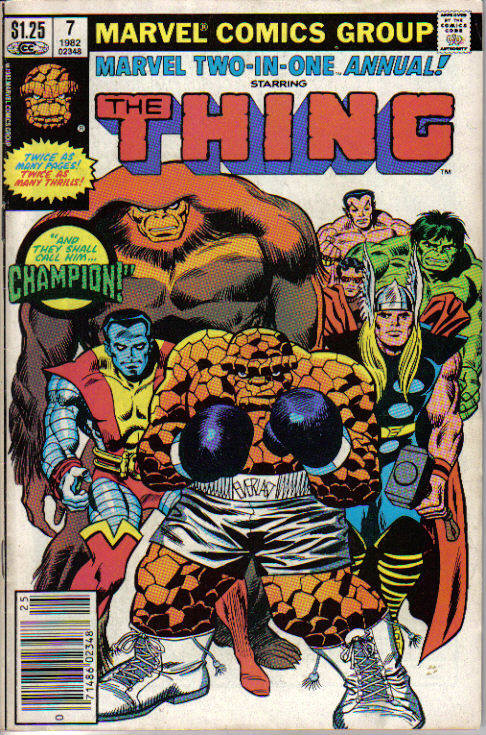
Today's comic, Marvel Two-in-One annual #7 came out before I was born, but my dad had a copy of it and I must have read it dozens of time. Actually, I flipped through it many, many more times than I read it. Marvel Two-in-One was basically the same as Marvel Team-Up, but starred the Thing instead of Spider-Man. It's also the opposite of Team-Up as that title existed so Spider-Man could star in yet another book, while Two-in-One seemed to exist because, well, the Thing couldn't bring in a large enough audience by himself. I could be wrong there, but that's the impression I always got.

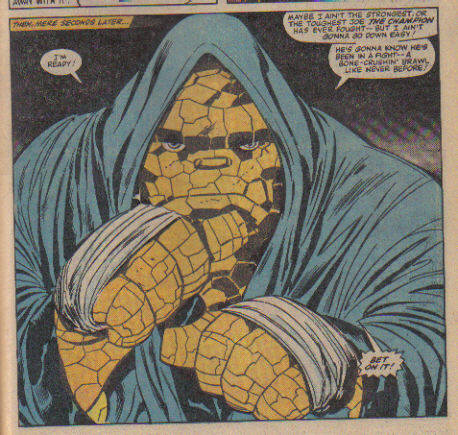
Now, the appeal of this issue (as the cover above indicates) is that the Thing doesn't share the book with one hero--no, he shares it with all of the other powerhouses of the Marvel universe (Doc Samson also shows up inside, but didn't make the cover). The plot is very simple: an alien boxing promoter shows up, kidnaps the eight most powerful heroes in the MU and has them train to fight the Champion, an intergalactic boxer who goes around challenging the strongest fighters on various worlds to boxing matches--just for the sheer thrill of it. So, they all train and then they fight.


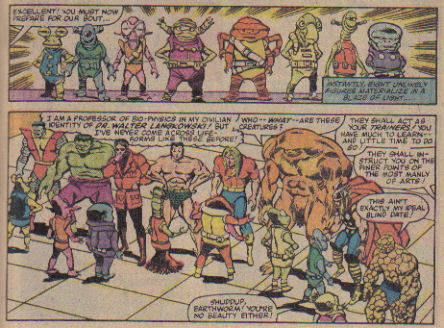
One of my favourite parts of the issue is the various little alien trainers the heroes each get:


I used to spend so much time just studying those little guys and matching them up with the heroes. I was an easily amused child, apparently.

Now, the training was fun as a couple of heroes are eliminated. Namor refuses to train and fight, because he's a pussy, so they kick him to the curb. Doc Samson is so bad at fighting that his exercise machine beats him up and his alien trainer deems him too incompetent to actually fight.

Thor acts like a jerk and uses his hammer, while the others all train following the rules--even the Hulk. Of course, in a line-up of Marvel's biggest and brightest, it's interesting that because it's Two-in-One, the Thing is automatically seen as the best of the bunch:


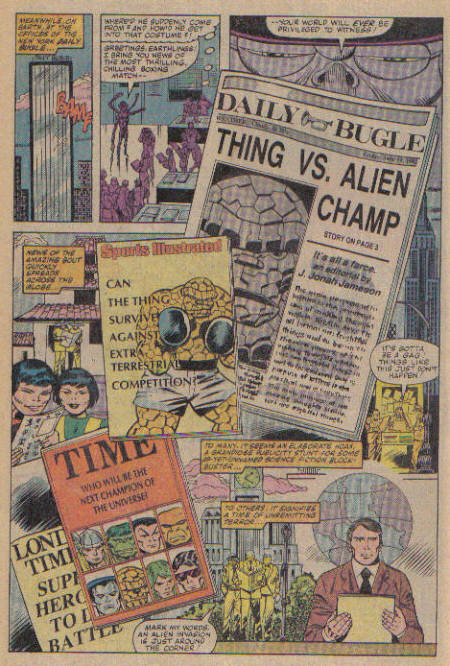
Now, is this simply because it's his book or because the people of the Marvel universe trust him the most? Look at the other heroes: Colossus is a mutant; Sasquatch is Canadian; Wonder Man is an actor; Thor is a viking; the Hulk is a monster; Doc Samson is a therapist; and Namor is an invading asshole. While you may argue over who is the strongest of the bunch, there's no doubt that Earth would look to the Thing as the best bet as he is a member of the Fantastic Four and best friend of Mr. Fantastic. While he may look like a giant rock-guy, he's proven himself not only a hero, but also an average guy. This guy was a fucking astronaut basically. In fact, this issue has a strange subtext that suggests that the Thing should be an American hero and celebrated as such. By this point in his life, no one would see him as a monster, they would just see a guy just like them who suffered a terrible accident and now does what he can to do the right thing.

The fights take place in Madison Square Garden in a ring surrounded by some sort of alien forcefield.

The first hero: Thor. He's disqualified for using his hammer, which he would put down, but if he's separated from it for more than a minute, he'll revert to Donald Blake. But, he just looks like an asshole.

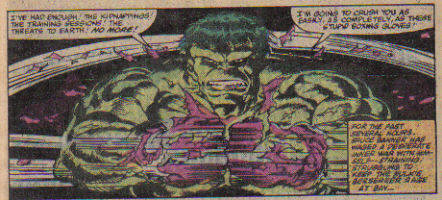
The second hero: the Hulk. And, he, uh . . .


The third hero: Sasquatch. He tries his best, but is knocked out quickly.

The fourth hero: Colossus. He also tries his best, but is beaten so badly the ref stops the fight.

The fifth hero: Wonder Man. He tries to fight, but gets his ass whooped, so he freaks out and tears up the ring. He's one of the Avengers now, you know.

That just leaves . . .


And he does is best. Up until this point, no one has EVER lasted a single round--on any world. The Thing last three complete rounds. He gives it as good as he gets and the only reason the fight doesn't continue is because the ref is concerned for his safety. The Thing, though, just won't quit . . .


The Champion then admits that he could never truly defeat the Thing as his spirit and will can never be crushed. He leaves, praising the Thing's courage and then the Thing falls over. The final panel is all of the heroes (not just the fighters) in in the ring, embracing him as the sold-out crowd goes nuts.

Okay, so maybe it rips off Rocky a bit, but it's still a great read. It's also the issue that made me love the Thing, because this sums him up: he may never be stronger than the Hulk or Thor, but he'll fight them with everything he's got and never give up. The Thing's real strength lies inside with his determination and motherfucking grit.

No idea what comic I'll do next or when I'll do it. A lot of the books I want to discuss are back at my parents' house in London, so maybe when I'm back for a visit, I'll grab what I can. In the meantime, I'll look through what I've got here.