Sunday, April 13, 2025

starless inscrutable hour 13

Uncanny X-Men #395 is about showing the intersection of the ‘real world’ and what it means to be a mutant within the context of being outside of the usual X-Men comfort zone. It’s both familiar and different, recalling past X-Men stories because X-Men comicbooks are about X-Men comicbooks. As the first proper issue of the Joe Casey/Ian Churchill run, it’s a little meandering and directionless. No high concept or clear statement of artistic purpose ala New X-Men #114 by Grant Morrison and Frank Quitely, it shuffles around London in the sort of vague manner of Casey’s Wildcats issues. Relationships are allusions, plots are barely there, and the world is a cold, uncaring place. While Wildcats seeks to answer “What happens to soldiers after the war?” Casey’s Uncanny X-Men work seems to try to answer “What happens after you leave school for the real world?” as it positions itself as something different from New X-Men, which focused on Xavier’s school and those still there.

Two answers/paths are given/explored. Chamber (aka Jon Starsmore) is a former member of the group Generation X and is in London, on his own. No longer a student after the dissolution of that group as the students go their separate ways, he’s alone in the world, staying at a crummy hotel, and finding himself in the company of the biggest popstar in the world, Sugar Kane. Casey is riffing on stories of Leila Chaney and Dazzler, while giving it a twist with the popstar not being the mutant. Instead, she’s intrigued by the tall, dark stranger in the leather jacket with the lower part of his face and chest spewing energy. Before ever taking the gig, Casey was asked by Wizard magazine once, for one of their specials, what his X-Men team would be (along with a bunch of other yet-to-write-the-mutants writers) and Chamber was his headliner. The cool visual, the inescapable nature of his powers, the fact that he’s somehow still treated as a bit of a broody teen heartthrob... you can make the argument that he’s the ultimate mutant star, the next step from Scott Summers and Sam Guthrie... The cover of this issue is a full-in shot of Chamber, energy chest/face taking up most of the image, his eyes just visible in the top left corner. While he’s our ‘star,’ the man is secondary to the mutant.

The unstated situation that Chamber finds himself in is that, upon leaving the ‘safety’ of Xavier’s school (or one of its offshoots in his case), what does a mutant actually do? What life specifically is Chamber suited for, particularly if he doesn’t have a strong desire to be an X-Man? There’s no hiding who he is. The moment he enters the comicbook, protecting Sugar Kane from the onslaught of fans, everyone knows he’s a mutant. He faces nothing but whispers and shouts and rude comments. His the walking embodiment of feared and hated, unable to pass as human no matter how he tries. As the Poptopia arc progresses, it becomes apparent that Sugar Kane is only using him to generate headlines and add a bit of controversial edge to her image. He’s the token mutant in her entourage until it becomes too controversial. Are those his only choices? Token mutant or X-Man?

The other option given is what the trio of Nightcrawler, Archangel, and Iceman encounter when they go seeking the source of a mutant spike that Cerebra (mutant-detecting technology at Xavier’s) pinged them to: a group of homeless mutants living underground ala the Morlocks in New York. These are the mutants that can’t pass for human who have ‘powers’ like acid-sweat, or gills, or one giant eye (the Cyclops). They live in squalor and fear, and immediately treat the trio of X-Men like outsiders even though they’re also mutants. These people do whatever it takes to survive, including killing intruders. This is what the world outside of the Mansion is for mutants... and Nightcrawler is a total loss of how to handle the situation. The X-Men are superheroes and students and teachers... but social workers or humanity relief workers? Particularly when this group of mutants doesn’t want their help. These former students taught to use their powers and help mutants encounter something that isn’t theory or easy ‘punch the bad guy in the face’ and they don’t have any idea of what to do. The conversation between Wolverine and Nightcrawler is enlightening as Wolverine is the stand-in for the wise old professor who’s got a ton of real world experience and is now passing on that knowledge to the next generation, and all he has is “MAYBE IT’S ENOUGH OFFERIN’ UP AN ALTERNATIVE. MAYBE HELP ‘EM GET OUT OF THE CITY...” before he moves on to the question of Chamber. Because it’s easier to avoid the real problems when you can focus on the simple stuff like a former student on his own in the world...

As an introduction to the idea of the X-Men operating out in the world, it’s all about putting up contrasts between what mutants and humans experience. The issue ends with a stark, brutal example where a human calling himself Mister Clean enters the underground area where the mutants are living and attacks them with a flame thrower. It’s panic and violence and death with the big reveal being that he looks like an actor straight out of an action movie. You could almost picture a movie doing gangbusters in this world where Arnold or Tom or Sly play this ‘Mister Clean’ killing all of those evil freaks as the hero.

It’s pretty obvious why a brand new era of X-Men comics centred on showing just how ineffective the X-Men actually are didn’t quite catch on. It worked for Wildcats, because that wasn’t the flagship title at DC (or even Wildstorm) by that point. It could be the quiet book about this group of characters finding their way through a life that was no longer familiar to them. Here, Casey is paired with Ian Churchill, an artist best suited to big bombast and action, yet is trying to write a comicbook meant for his Wildcats collaborator, Sean Phillips (who would draw future issues of this run). Sometimes, when the writing and art work at crosspurposes, that juxtaposition can produce something greater and more interesting; others, it sinks the project through no specific fault of anyone. Welcome to the real world... welcome to the show...

Saturday, April 12, 2025

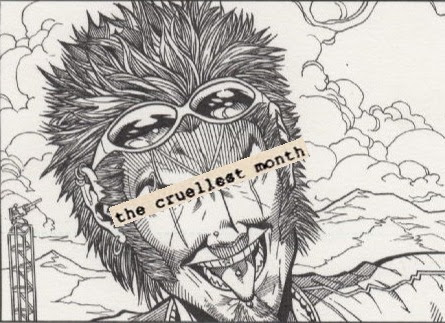
the cruellest month 12

A thought exercise (that I’m not sure I’m capable of)

Imagine: You are a brand new superhero comicbook reader. It is 2001. You saw X-Men in theatres the year before. You’re walking down the street. You pass by a comics shop, see a poster for the new X-Men comics by Joe Casey, Grant Morrison, Ian Churchill, and Frank Quitely. It’s maybe even a poster featuring Quitely’s take on the characters where they’re standing on the steps of a memorial for humanity, Xavier up front, the yellow of the Xs on their jackets brightening things up, Wolverine’s chest exposed even more than Emma Frost’s. Something about the image catches your eye, so you go in, and you ask for the X-Men comic from the poster. The guy behind the register says that that specific comic hasn’t started yet, but it’s launching aside another X-Men run, and the first issue of that comic just came out. He grabs you a copy of Uncanny X-Men #394 and the cover immediately seems somewhat familiar. You remember Wolverine and that redheaded woman must be... Jane? She was with the guy with the glasses. You pay your $2.25 USD ($3.50 in Canada!), take it home, and, later, give it a read.

Question: What do you, as this hypothetical reader, think about this comicbook?

Assumptions: You understand how to read comicbooks. You may have read some when you were a kid or you read newspaper comic strips. Basic comprehension of words, pictures, and the proper flow of the comic are not an issue. Your only experience with the X-Men, though, was the movie.

Answer 1: You enjoy it. The villain is a bit strange, but in a fun, energetic way. You like that the issue mostly focused on Cyclops, Wolverine, and Jean (her name is Jean, not Jane! you mentally chastise yourself) because you know those characters. The situation reminded you of the movie. The art made the characters look familiar and the way that things melted by the powers of Warp Savant was cool-looking. The blue guy with wings was kinda cool, too. If you remember, you may pick up another one.

Likelihood: Eh, maybe?

Answer 2: You don’t enjoy it. The villain is just an 18-year old punk trying to do what exactly? You like that the issue mostly focused on Cyclops, Wolverine, and Jean (her name is Jean, not Jane! you mentally chastise yourself) because you know those characters. The situation reminded you of the movie. The art, while fine, didn’t look like the poster in the window. Where was Professor X and Magneto? The bad guy mentioned Magneto, but wasn’t Magneto in this comicbook? Isn’t he the X-Men’s bad guy? And was the blue guy with wings the same blue guy in the poster? That one looked more like an animal. Can this guy turn himself into animals? Is that why he has wings? You probably won’t pick up another one.

Likelihood: More likely.

Solution: I’m finding it hard to put myself in this position. I’ve literally been reading comicbooks since before I could read. They were always there. But, setting aside comicbooks, I’m not sure I find it possible, myself, to enter into anything this fresh. Everything has some set expectation or point of reference. I can’t picture picking up something like a comicbook and treating it in this way, yet that’s precisely how people talk about them. And I know it happens because I’ve seen the anecdotes from retailers. People are just this uninformed walking into comicbook shops sometimes, doing so on a whim because they saw a poster and remembered a movie, and I don’t understand it. I don’t quite buy it. I’ve never seen the point of chasing that sort of person. It’s like hearing that, according to research, when people really liked a television show, they apparently only actually tuned in for one in three episodes. I don’t understand that mentality. And I’m not sure Joe Casey does either. Sure, he put on his ‘marketing hat’ to have Logan and Jean make out on the cover (and inside), but this doesn’t read like a comicbook aimed at new readers. It feels like that’s just a disguise or an excuse or a vague hope that he never believed possible. If this comicbook ever feels ‘phoned in’ or lacking, it’s in the conviction that it would ever convert some random person into being a steady reader of Uncanny X-Men. I don’t think Marvel ever did either. Do you know how I know? Flip through the issue and notice the big ads for New X-Men that aren’t there. Or the editorial pages hyping up this new era that also aren’t there. Nothing about this suggests that there’s a world of X-Men outside of this issue beyond the implication of the issue number and the tiny caption at the bottom of the last panel on the final page that says “next: poptopia” like that’s supposed to mean anything. The only people who would pick this up and understand what’s going on in the context outside of the actual issue are existing readers. That is the target audience, always. Always. The closest to a window into other comics outside of this one is the Bullpen Bulletins page that has a list of comics out the following week and four pages of unlettered art for X-Treme X-Men #1 (out the following week). No context, no indication of what relationship those X-Men have to these ones. This was never new-reader-friendly and it was never meant to be.

Conclusion: I was not capable.

Friday, April 11, 2025

the cruellest month 11

Unreal City

Under the brown fog of a winter noon

An area of Uncanny X-Men #394 that I’ve been pondering well before I ever conceived of this examination of the issue is Warp Savant’s powers and his methodology in attacking the Cape Citadel military base. His powers have always been like an itch that I can’t scratch, mostly in how it relates to Magneto, The X-Men #1, and the entire concept of reliving that moment in time. The ability to teleport/absorb matter inside his head isn’t akin to magnetism at all and it’s always kind of bugged me. Okay, I know, I know, the answer is that Joe Casey thought the idea was cool and there was no deeper meaning. But that’s not how we play ball here, my friend. Yesterday, I compared his powers to the absorption of random comicbook knowledge by hardcore fans and his attack as a declaration of adulthood. In the literal sense of what he says and does, though, I’m curious what we can find...

The issue opens with the caption “THEY SAY IT’S YOUR BIRTHDAY...” and Warp Savant at his computer, smoking. When he comes across a Daily Bugle article about Magnet’s attack on Cape Citadel, he leans forward, eyes wide, big grin, and says, “SWEET.” The next night, he’s at a club and tells some girls that “COME TOMORROW... / ...I’M GONNA BE CELEBRATING. / BIG TIME.” In the club, he seems bored. The three scantily-clad girls barely cause him to react. He absorbs a bottle of beer using his powers. What effect does that have on him? He’s bored with his life. He’s been sitting on these powers and while his scene thinks he’s cool, he’s stagnating.

The attack on Cape Citadel reads more like a Looney Tunes cartoon than anything. He comes in, begins absorbing everything, yelling stuff like “OUT COME THE FREAKS! AND WAR’S NEXT ON THE AGENDA! / I’M A MUTANT AND I’M EVIL!” His response to a clichéd general (spouting phrases like “What’s your major malfunction?”) is to salute him, mock him, and give him a kiss on the forehead before using his powers on him. That Warp Savant seems more like Bugs Bunny than Magneto is an odd choice for Casey. It almost recalls and mocks Magneto haughty self-importance in The X-Men #1, opting to treat the entire exercise as a farce. As he continues, he muses about his motives:

THE DIRT FARMERS AND THE POLITICIANS... THEIR FEAR IS OUR GREATEST WEAPON!

IF BUCKET-HEAD WON’T SHOW HIS FACE TO TEAR IT ALL DOWN, I’LL TAKE THE HEAT, BAY-BEE!

I’LL GIVE ‘EM AN INCIDENT THAT’LL DIVIDE OPINION!

I’LL SHINE THE WORLD--!

At this point, he’s interrupted by Wolverine’s appearance from the sky. His little rant suggests he’s actually got a motive and a goal. To shock humanity? To scare them? To burn the world down? It’s hard to parse where he’s going exactly, except that, here, he’s completely in line with Magneto who never revealed his actual plan when he attacked Cape Citadel. It was the first phase of a plan to show off his power to make humanity bow before him and all mutants somehow. He never does much prior to the X-Men defeating him, similar to Warp Savant here.

One idea is that Warp Savant, by taking people inside his head, literally shows them his perspective. He’s the living embodiment of empathy in action, except the inside of his head is a war zone called City Hell (a play on Citadel) or childish nightmares. It’s all so much like a child smashing toys together. It’s interesting that only Jean and Logan seem to have true agency inside Warp Savant’s head. Maybe because they’re mutants? They understand and can navigate his world. It’s not entirely clear and Warp Savant’s all over the place behaviour doesn’t help.

Part of the problem, according to Casey, lies in his writing: “I think the imagery I was conjuring up in my mind when it came to the ‘virtual space’ where victims of Warps powers would find themselves was 1) bizarrely misguided creatively and 2) asking Ian Church to draw something that didn’t quite come naturally to him.” I think it’s refreshingly honest to take the heat completely, including absolving Churchill for not executing those parts of the issue as well as, say, Ashley Wood may have; what I’m intrigued by is the “bizarrely misguided creatively” part. I think I know what he’s getting at, yet the idea of a psychic plane where characters are transported isn’t new to an X-Men comic. What is new is how ambiguous the whole thing is with Warp Savant not actually in control of the environment in his head. It’s a shifting reflection of his inner world but outside of his direct influence.

Heading down this line of thinking, his act of seeming suicide could be an effort to ‘find himself’ now that he’s out in the world. Or is it the final act in his attempt to shock and divide? What’s truly missing and actually undercuts the issue is that Warp Savant is treated like almost nothing once he’s gone. The focus shifts to the Jean/Logan melodrama and it’s like Warp Savant was never there. Gone forever so far, which is rare in superhero comicbooks.

Thursday, April 10, 2025

Thorsday Thoughts – The Ultimates #11

Thor comics aren’t usually overtly political. Despite a central location being a kingdom, even when war is made, it’s usually plot-driven and divorced from broad political ideas. If anything, the focus is usually personal and through a bit of a superhero lens. If Asgard goes to war with Surtur, it’s because Surtur is an evil fire demon bent on destruction and nothing more. If the Frost Giants complain about Asgard’s foot on their necks, it’s only because they would ravage and devour Asgard if given the chance. These are mythological beings that fit into archetypes of good and evil, neat little boxes. Broadly speaking, Thor is a heroic figure, generally on the side of good where the concept of politics is boiled down to simplicities and privilege. He’s a defender, not a conqueror or coloniser, despite his followers being those things. Politics are somewhat slow and temporary for someone like Thor who views the rise and fall of empires the way we view the rise and fall of the sun. Placing Thor in an overly political context seems strange at first glance.

Then again, this isn’t a Thor comic. It’s The Ultimates.

Part of the Jonathan Hickman-led relaunch of the Ultimate Universe, the basic idea is that the Maker (Ultimate Reed Richards) remade universe 6160 in a manner to his liking, mostly by using time travel to suppress the Age of Marvels. Now, after he was trapped in the City for two years, Tony Stark and Doom (that world’s Reed Richards) have gathered a group of superpowered insurgents to prepare for the day when the City opens again, to take down the Maker. During this preparation, they’ve been trying to right the wrongs of the Maker, one of which was freeing Thor from the dungeons of Asgard where the king, Loki, had put him, marking him a traitor. In The Ultimates #11, Thor and Sif (his former jailer) return to Asgard to end Loki’s reign, the issue told via splash pages and a long poem.

Deniz Camp has written The Ultimates less as a superhero team and more as an activist cell. It’s been rare for the full group to appear in an issue, shifting its central focus each month to build a tapestry of the group’s activities and the world around them. He’s also done his best to treat each issue as its own unity of storytelling, attempting different formalist experiments, like the fourth issue telling four different narratives across every page with a panel on each page dedicated to each. As an issue of The Ultimates, this fits structurally and narratively with its focus on only Thor and Sif (with appearances by Stark and Doom at the very end) and told in a unique, specific manner. Thematically, its exploration of a fascist state, the means of oppression, and the ways in which the oppressed learn to live with it, afraid to fight back for fear that things will get worse, is very much in line with rest of the series, which has been a comic about resistance against tyrannical rule, both overt and covert.

It also features the book’s regular artist, Juan Frigeri, and, I imagine, he was pretty pumped to have an issue of splash pages where he can channel everything into single issues that allow his detailed line work to shine. It’s a different sort of storytelling, one that actually accomplishes that rare feat that everyone talks about as the standard for quality visual storytelling: the ability to follow the story without the words. Told through a series of single images, each representing a chunk of time or a moment, Frigeri manages to nail it page after page. Together with Camp’s poem, the effect is more like a children’s book than a regular comic. Fitting for the mythological characters featured. Despite its connection to the larger world, this issue is almost a fable of fascism and resistance, of disruption and endurance. Characters are more impressions and single images than flesh out, and the story is dead simple and straight forward: Thor and Sif arrive, obtain the means to move about the Realms in secret, we’re told of the status quo, they try to enlist help and meet with scared apathy, they begin to strike, the ruling class hits back against the citizenry, and things head towards open conflict. The message is dressed up with poetic language, yet is very directly put:

You don’t make concessions

To autocrats and their oppressions

You don’t make deals

With tyrants

You make war!

The closest Thor comic that comes to mind is the Robert Rodi/Simone Bianchi Thor: For Asgard six-issue series. Also not taking place in the regular Marvel Universe, For Asgard tells of a time where Thor is king of Asgard and grows slowly more tyrannical with time, making choices that seem good for Asgard but incorrect morally. The big reveal at the end of the first issue is that he can no longer lift Mjolnir. As the story progresses, dissent is sown by unknown provocateurs and acts of sabotage are committed against Asgard, all while the younger generation pushes back against tradition. It seems like this is the slow death of a once-great kingdom until Thor finds a way to reclaim his former worthiness. By the end of the final issue, it’s clear that the story was meant to continue (but never did) and is only the first step in how to heal a nation that has begun to erode and die. (The issue also recalls the Loki mini-series also written by Rodi, but drawn Esad Ribić where Loki finally conquers Asgard and finds the throne not as comfortable as he always dreamed, though that is much more of a character-driven story with any politics merely there to serve Loki’s story.)

During Matt Fraction’s run on Thor, he changed the ruling structure of Asgard, first with the triumvirate All-Mothers taking over for Odin and, eventually, the Congress of Worlds, a democratic government made up of representatives of the various Realms. Despite these changes, there was little substantive longterm impact on Asgard. As is the usual way with superhero comicbooks, time passed and things reverted back to tradition. Thor comicbooks aren’t usually political.

The Asgard presented in The Ultimates #11 is one shaped to suit its thematic purposes. Camp twists known elements in the ways needed to tell his story. The largest change is to the Vanir, normally depicted as a race more or less the same as the Aesir. Here, they become something akin to the Fae and fill the role of those that are comfortable enough under the oppressive rule, afraid to lose what little they have by fighting for more. Of course, when Loki and the Frost Giants look to put the screws to the populace following Thor and Sif’s first attack, the Vanir are among the first group to have their rights limited. It’s an interesting play on the traditional tensions between the Aesir and Vanir in the comics where war between the two was settled via Frigga marrying Odin, and the Aesir ruled over the Vanir in a benevolent-yet-chaffing manner. The echoing of that arrangement implicitly calls into question the justness of Odin’s reign. While more benevolent and fair than Loki, the line between monarch and tyrant is a thin one.

That there’s no resolution in this issue is the boldest choice. A morality play such as this would seemingly be best served with a clear ending: the downfall of the tyrant king. Instead, the big payoff is the message from above about resisting, not appeasing, tyrants. It’s not the actual final word of the Thor portion of the issue. While the war against Loki is implied at the end, so too is one Thor’s methods: a deal with Surtur where he enlists the fire demon to “Burn it all down.” Again, Camp uses previous stories and conventions to imply action. There have been countless comics where Surtur attempts to bring about Asgard’s destruction and Ragnarok, and it’s even shown up in a movie (you may have seen it). While a lot of the story doesn’t actually rely on regular Thor continuity, that moment is surprising in how it references such a well-known Thor trope. It almost feels out of place in an issue that seeks to demonstrate just how different this Asgard is from the one we know in service of its message. And that’s where I land with this issue, taken from the viewpoint of a Thor-focused reader: it uses the characters and setting in a manner that fits the message it wishes to convey.

In many ways, this could have been a story about Hercules and Olympus, or Namor and Atlantis, or Black Panther and Wakanda. Pick a ‘country’ in the Marvel Universe and a similar issue could be told. The poem approach seems to suit Asgard conceptually and the idea of finally seeing through an Asgard under Loki’s rule is appealing. Thor as an insurgent guerrilla fighter has an odd charm as well. These characters work well as simple metaphors for this message of resistance and no appeasement, partly because of the contrast with the Asgard that we know. And it’s incredibly relevant for the current times, another rarity of Thor comics.

the cruellest month 10

Unreal City,

Under the brown fog of a winter dawn

Now that we’re into Uncanny X-Men #394 proper and have settled on the reasoning for each of our heroes, what of our villain? Or, to be more accurate, antagonist? Warp Savant was created by Joe Casey and Ian Churchill for this issue only and has not been used since (that I’m aware). I’d pin the lack of followup on the character’s seeming death were it not for the fact that the death was far from certain and that, even if it were, since when did that ever stop anyone in the superhero comicbook game? Warp Savant’s inspiration, Magneto, has died how many times only to return after each eventually? Is it the one-note nature of the character? Again, that’s never stopped anyone. The truly unbeloved nature of this issue? Or something more central to his core?

What do we know about Warp Savant coming out of this issue? He turns 18, he’s male-presenting, he’s heavily tattooed, he wears sunglasses on his head (but never over his eyes), he likes leather pants and mesh shirts, he goes to clubs, he has the ability to teleport objects inside his own head (and seemingly prefers to imbibe alcohol that way), and he’s a Magneto fanboy. No real name, no tortured origin, no real motivation other than mindlessly striking out at the world... The inciting event for action seems to be becoming an adult. Given that mutant powers present at puberty generally, that means Warp Savant has lived with his powers for around four or so years, maybe more, maybe less, and it’s only when he’s reached adulthood that he looks to use them beyond limited means (like ‘absorbing’ beer bottles).

As much as Warp Savant patterns himself after Magneto (more on that later), he’s paired with Cyclops here, acting as the opposite to him. Cyclops’s comments about there being a world beyond the mansion walls are key; just as Cyclops is looking past the world of the school, so too is Warp Savant, leaving behind the safety of childhood and going out into the larger world, looking to make a difference in the only way that makes sense to him. Both men are looking to ‘change the world’ in their own ways (Cyclops even makes reference to this idea at the end of the issue). While Cyclops is all repression and control, Warp Savant is the opposite. He’s mindless energy, letting loose his id, and not actually acting with a plan. When he storms Cape Citadel, it’s with a vague idea of ‘shaking things up’ and no real goal. Even when he’s defeated by the X-Men, he doesn’t seem that upset. He almost seems amused, ready to go with the flow, and embrace the next step by using his powers on himself.

Visually, the two characters are related but different. Both wearing leather jackets and sunglasses (almost identical save the colour), with Warp Savant never actually putting his over his eyes, unlike Cyclops who had to keep his over his eyes or else unleash his mutant powers. Given the twinkle in Warp Savant’s eyes when he uses his powers, the eyes seem important there – maybe he can only affect what he sees. It’s these little connections...

That Warp Savant waits until he’s 18 isn’t about him leaving school entirely, either. It also puts him beyond the reach of school – beyond the reach of the X-Men. He’s no longer young enough to immediately fall under the sway of Xavier’s teachings. Not in a literal sense, because plenty of X-Men joined the team as adults (an all-new, all-different concept, one might say). Warp Savant doesn’t exist in the realm of the literal, though. He’s a walking, talking, drinking, fucking metaphor for an alternative to Xavier’s dream. Every part of the character is designed to not fit into Xavier’s school and his teachings, including his patterning his first step into the wider world on the actions of Magneto. In The X-Men #1, Magneto’s attack on Cape Citadel is just as ill-conceived and pointless. An act of terror that declared that he would answer to no one – and that’s what Warp Savant is doing. It’s a declaration of his adulthood and unwillingness to be cowed by anyone. There is no message beyond that. “I’m a mutant and an adult and I won’t be told what to do!” He strikes against one of the most potent symbols of authority in the military and has no agenda past the lashing out. Even the declaration that he’s an evil mutant is merely in response to society around him that would classify him as such, trying to provoke him to change and conform, so, instead, he owns the label.

The final thing that Warp Savant stands in for is us, the readers. Or, rather, to keep harping on it: X-Men comicbook readers (because X-Men comicbooks are about X-Men comicbooks). The issue begins with him researching continuity online and he spends the issue collecting facts inside his head. In the aftermath of the X-Men movie, there was an element of comicbook fandom that pushed back against the mainstream success, wanting to assert that that wasn’t the real X-Men and the movie fans weren’t real fans. Warp Savant is a moody geek lashing out at the world that treats him like an outcasts because he knows the continuity. Jumping from there, it's not hard to see him as a stand-in for Joe Casey (except Joe is rarely seen without sunglasses covering his eyes), a notorious continuity hound and provocateur. It’s a stretch, honestly, but I do see the character as giving some insight into the ensuing Uncanny X-Men run that, in contrast to New X-Men’s school-based location, would be about going out into the wider world and encountering ideas that challenge Xavier’s view of human/mutant relations. Warp Savant is merely the first...

Wednesday, April 09, 2025

the cruellest month 09

Why does Joe Casey decide on these four X-Men in Uncanny X-Men #394? Cyclops, Jean Grey, and Wolverine are actually pretty obvious. Aside from Professor X and Storm, they’re probably the most memorable X-Men from the movie. They also have the whole love triangle “interpersonal soap opera” plot that drives the issue and will continue, after a fashion, in Grant Morrison’s New X-Men. Moreover, as I’ve said before, Cyclops and Jean are both part of the original X-Men that fought Magneto at Cape Citadel in The X-Men #1, and Wolverine is, bar none, the most popular X-Man of all time. Those three are both essential to the story told here with no other characters able to take their place, while being incredibly well known, popular, and fit the allusion to the first X-Men comic.

That leaves Warren Worthington III aka Archangel.

There are two influencing factors in this choice: original X-Men and a member of Casey’s Uncanny X-Men cast moving forward. Setting aside Professor X, as part of this story was the X-Men being the adults and the evil mutant being the child, and they don’t look particularly adult with their teacher still bossing them around, that leaves Archangel, Beast, and Iceman. Beast is the only one of those three not part of Casey’s cast and, in fact, was a central member of the New X-Men cast, so he was out. With Iceman and Archangel to choose from, it’s tempting to call it a coin flip since Warren doesn’t actually do a lot in this issue. He shows up, fires the weapon that disrupts Warp Savant’s powers, makes a quip about living fast and dying young, and that’s it (oh, and his first panel is a great visual callback to his pose on the cover of The X-Men #1). I guess that’s it. With two natural choices, Casey just picked at random... Except...

Of the two characters, Archangel looks less human. In an issue where five mutants appear, four of them could pass for human. Sure, Logan and Warp Savant have fairly specific looks to them, and that’s all. They look human. Particularly in this new era where the X-Men costumes are leather outfits that resemble a flashy biker gang or maybe a breakdancing troupe, none of these characters pop off the page as superhuman in any way at first glance. Even Iceman only looks different from any other person when using his powers. Otherwise, he’s just as bland looking as everyone else. Warren, at least, has blue skin and wings. Of the original X-Men who are also members of the title moving forward, he’s the ‘freak’ of the bunch. He adds that otherworldly, altered element of mutants to the issue. If that was the only reason, Casey would have been better off choosing Nightcrawler, honestly, from the Uncanny cast. While not an original X-Man, Kurt Wagner is more the face of ‘freak’ X-Men and would have given Ian Churchill some fun situations with him teleporting around, firing the blaster to disrupt Warp Savant.


Warren’s presence actually relates to the “interpersonal soap opera” drama at the heart of this issue. As I keep saying, this issue is actually aimed squarely at X-Men fans despite the appearance of appealing to new readers. The superficial marketing is new-reader friendly, the true meaning is only for the hardcore. The love triangle in this issue is Scott/Jean/Logan, but, if you go back to those origin Stan Lee/Jack Kirby issues, it was Scott/Jean/Warren. Moreover, many of those initial issues had Jean showing pretty obvious affection for Scott, while he seemingly gave her the cold shoulder, partially out of obliviousness, partially nervousness, and partially because he didn’t think someone like Jean would be interested in him. Despite seeing that Jean preferred Scott, Warren, more flashy and confident than Scott, took advantage of the situation often to try and win Jean over. Eventually, when it became apparent that there was no getting between them, Warren moved on and, in a new story in Classic X-Men #1, when he sees Logan’s interest in Jean, steps in to tell him to back off. Here, he’s a reminder of both that original love triangle and that there’s no getting between Scott and Jean, because Jean cares about Scott too deeply. Casey doesn’t give any dialogue to even hint at this past, it’s all subtext for those that know. And, of course, knowing what eventually happens in New X-Men, it also confirms that Logan would not be able to get between Scott and Jean, because Jean could not be tempted away from Scott. Scott, on the other hand...

Despite these reasons, was this the best team that Casey could select for this issue? I still think that Nightcrawler might have been a better option than Archangel. It’s unusual to only see a roster of four X-Men, especially as the cast had ballooned so much over the years. With the focus on Scott/Jean/Logan, and giving enough space to Warp Savant, there isn’t much room for any other characters, so additional X-Men would have filled a similar role to Archangel: add to the fight against Warp Savant, have four or five lines, and not actually contribute much. The added subtext of Warren’s presence does a lot of the argument for his inclusion, checking off numerous boxes: original X-Man, less human looking, member of Casey’s Uncanny cast, love triangle... I guess he was the character filled with the most meaning simply by being there...

Tuesday, April 08, 2025

the cruellest month 08

In Uncanny X-Men 394, Joe Casey’s dive into “interpersonal soap opera,” as he’d later describe it, uses what would be a key point of Grant Morrison’s New X-Men, Scott and Jean’s strained relationship in the wake of his experience as the vessel for Apocalypse. In particular, highlighting Scott’s cold and distant behaviour. On the surface, he doesn’t actually seem that different given Scott’s usually reserved nature. He’s a no-nonsense kind of guy who’s settled into the leadership role of the X-Men largely because of that singular devotion to the role. Again, the depiction of Scott here isn’t aimed at new readers. It’s not even aimed at casual readers because at no point does Casey allude to the Apocalypse possession or its impact upon Scott. At best, he points towards some underlying tension between Scott and Jean, having Wolverine take advantage of it.

Except, of course, the Apocalypse possession doesn’t actually matter. While it’s an underlying cause of Scott’s behaviour here that explains why he may be acting a bit differently from his normal comicbook personality, the love triangle subplot had, largely, been dormant in the comics for quite a while. It received a hint around the marriage of Scott and Jean and that’s about it. No, what brought it to the forefront, and is where both this cover and content of this issue was aimed at new readers, is X-Men, the movie that had come out the previous year. The Scott/Jean/Logan love triangle was an element of that movie and, if you’re going to play up the soap opera for new or casual readers, taking the one soap opera element from the wildly popular movie featuring the characters was the way to go. Along with the leather outfit costume designs, this was the big influence of the movie upon the Casey/Grant Morrison era with Morrison being the one that leaned heavier into the influence of the movie. After this issue, you wouldn’t know that Casey had ever seen it from the direction he took Uncanny X-Men. For one issue only, Casey dove into the movie influence and did the work to actually set up Morrison’s New X-Men run more than his own Uncanny X-Men run.

Depicting Scott as cold, obsessed-with-the-job guy actually falls mostly on Ian Churchill’s shoulders. Casey’s dialogue without Churchill’s body language wouldn’t land quite the same way. Throughout the opening scene where Scott watches the news broadcast and, then, learns of Warp Savant’s attack on Cape Citadel, Churchill plays up two things: a sour, almost scowling facial expression and the closed off arms crossed posture. At no point does Scott’s expression or body language change. The closest we see him move is turning his hand with his arms still crossed, standing up straight, and the same scowl on his face. He looks like he hates the world around him and doesn’t want it to let any of it in. Yet, he’s watching the news broadcast and setting up the mission to Florida, because the only thing he seems to care about is his role as leader of the X-Men. In fact, the only way he engages with the outside world is through that role as he mentions to Jean that they need to remember the world outside the mansion. If he isn’t actually closed off from the world and is actually trying to put the X-Men into it, what his look and posture are actually guarding him from is Jean.

When Jean and Logan leave to confront Warp Savant, she kisses Scott’s cheek, saying “LOVE YOU, SCOTT.” Stoically, he looks ahead, arms still crossed and responds, “LOVE YOU, WIFE.” It’s a cold thing to say, depersonalising her to the specific role in their relationship, as if his loyalty is to the arrangement rather than to her. The following panel is Wolverine looking on, clearly taking in the strained marriage. Wolverine’s role in this drama is one that I’ve always found odd to give a seemingly heroic character: the other man. Given what we know about Scott’s recent history, he’s actively taking advantage of the trauma Scott went through to hit on his wife... it’s really scummy. (Wolverine, though, shortly before Scott was possessed by Apocalypse was similarly under the spell of the ancient mutant, acting as the newest incarnation of the Horseman Death, so, you could argue, that puts them on similar ground.) On the plane to Florida, there’s a brief interaction between Logan and Jean:

Logan: PROBLEMS BETWEEN YOU AND CYKE?

Jean: ...

Jean: NO. WHY DO YOU ASK?

Logan: BACK THERE... YOU TWO DIDN’T SEEM TO COZY—

Jean: JUST MIND YOUR BUSINESS, LOGAN.

It’s a quick attempt to put himself into the situation met with an equally quick rebuff, which is what you’d expect in this situation. After all, Casey isn’t looking to actually explore the love triangle idea in depth, merely reintroduce it before Morrison does with it what they wish. It’s about laying the groundwork and, after the two are absorbed into Warp Savant’s psyche and battle their way through, they find themselves seemingly about to die. Just as reality dies around them, Logan takes advantage of the opportunity to passionately kiss Jean and they seemingly blink out of existence that way. Instead, they’re returned to reality as a result of Warp Savant’s seeming suicide and Jean is left shaken, seemingly unable to recall the experience. When Logan says “I REMEMBER, JEANNIE. EVERY BIT OF IT. / JUST ANOTHER DAY ON THE JOB, EH...?” her uncertain look back at him and response of “... / RIGHT.” leaves it unclear how much she does remember of the experience. Their kiss is left as a brief moment at the edge of seeming oblivion that, possibly, only one of them remembers – and a moment that Morrison and artist Phil Jimenez would later repeat in another near-death scene in New X-Men aboard Asteroid M.

While Jean and Logan were in Warp Savant’s mind, Scott was trying to subdue the young mutant alongside Archangel and, at the moment where the final blast from the weapon that temporarily disabled his powers, Scott stands over him, gives a little speech that ends with him asking “...WHAT DID YOU DO TO MY TEAMMATES? / MORE IMPORTANTLY-- / --WHAT DID YOU DO WITH MY WIFE?!” It’s actually the same question asked twice as the only X-Men Warp Savant used his powers on were Jean and Logan. The extra emphasis on Scott’s wife reminds us that he loves and cares about her beyond his role as team leader of the X-Men. The words “more importantly” places her as his wife above her as his teammate. Yet, it also echoes his “LIFE YOU, WIFE” line from earlier in the issue. Is it love or something more possessive? More about the formality of their relationship? Does he love Jean or is he committed to their marriage as a concept despite his struggling with what he feels? When she and Logan return to the real world, his concern for her seems genuine, bordering on panic when she’s weakened/injured coming back. There’s enough ambiguity presented to play into the idea that something is amiss.

The issue leaves it as all suggestive and, as I said, for Morrison to pick up again. Jean doesn’t appear again in Uncanny X-Men as long as Casey writes it, I believe. His instincts to introduce his and Morrison’s time on the books by playing off the movie and setting up Morrison’s title shows a shrewd commercial instinct that wouldn’t really show up again during his time on the title.

Monday, April 07, 2025

the cruellest month 07

The cover of Uncanny X-Men #394 is the most memorable aspect of the issue, Joe Casey was right about that. As I said yesterday, it owes more to romance novel covers than your typical superhero comicbook cover, and only really works if you know the characters and their history. Jean Grey is married to Scott Summer, but has always had a certain attraction to Wolverine. It had been teased numerous times in the past with it made clear that the attraction was larger on his part than hers, though still mutual. In the Age of Apocalypse event where Charles Xavier’s son went back in time to kill Magneto but accidentally killed Xavier, Apocalypse conquered North America and, in that world, Jean Grey and Wolverine were together. It was the last true outlet for this tension, allowing fans to see the two as a couple in a setting that didn’t actively ruin the relationship of Scott and Jean, because it was an alternate reality outside of continuity (though not entirely, admittedly). Depicting Jean and Logan passionately kissing (and dry humping) was a lurid attempt to garner attention, though, unlike many comics that try the same trick, the moment depicted on the cover does happen in the issue, so it’s not entirely a bait and switch.


While understanding the shock value of the cover requires prior knowledge of the characters, the Ian Churchill-drawn cover goes beyond that level of insight. Similar to the rest of the comic, it’s an X-Men comicbook cover about X-Men comicbook covers. Specifically, it recalls a trio of Andy Kubert X-Men covers that all occurred during the same year, and all contain an element that this cover plays off of.

X-Men #24’s cover depicts Rogue and Gambit in a slightly distanced embrace, Rogue being held off the ground similarly to Jean. While they’re not kissing, it looks imminent, suggesting a moment long teased in X-Men comics. The romance between the two was always alluded to and danced around due to Rogue’s power to absorb the memories, powers, and life essence of anyone she made skin contact with, preventing her from all but chaste relationships. This was contrasted with the overly flirty Gambit, who was meant to ooze charming but kinda sleazy sexuality. They both clearly wanted each other but couldn’t have one another much like Jean and Logan. What held Rogue and Gambit apart was her powers, while Jean’s relationship with Scott always stood in the way of Logan. The visual callback to a previous teasing ‘shock’ cover of a long-bubbling romance that didn’t actually end with the payoff fans (possibly/supposedly) wanted is the key element here.


X-Men #28’s cover depicts Sabretooth looming over Jean in a threatening manner, not quite lifting her up (his right arm is positioned incredibly awkwardly), but nearly doing so with his left arm raised high above, ready to strike, while his mouth is open in a violent hissing/biting sort of look. In this image and the issue, Sabretooth is a stand-in for Wolverine. At this point in the X-Men’s history, Wolverine was gone, dealing with the aftermath of Magneto ripping his adamantium skeleton out in Fatal Attractions, while Sabretooth was the prison/patient of Xavier as he tried to rehabilitate the murdering flipside of Wolverine. In the issue, Wolverine’s absence is deeply felt as Jean is close to marrying Scott and various feelings are being second-guessed, heightened by that event and the damage Wolverine recently suffered. The posing on the cover is much more threatening than the embrace on issue 394’s cover, but the positioning isn’t too far off. Despite Sabretooth’s clearly imposing violent nature, Jean doesn’t actually look afraid. Startled, perhaps, taken off guard... but not afraid. She’s not afraid of the wild, violent side of Wolverine. She’s poised and able to handle it, confident in herself and her abilities. Despite the allure of the less restrained Logan compared to the ultra-repressed Scott, she loves Scott and remains committed to him. (And I’ll direct you to Kayleigh Hearn’s excellent piece at Shelfdust on this issue.)

X-Men #30’s cover is the only of the bunch to actually feature a background. Depicting the wedding of Jean and Scott, the cover is actually a double-spread to show off all of the guests at the wedding, but the main focus of the traditional cover space is the first kiss as a married couple of the two. Again, as with every cover, the woman is on the left, while the man is on the right (weird) and it’s the most literal visual comparison to the Churchill cover as it features Jean kissing a man. Comparatively, it’s a more posed and perfunctory sort of kiss, as is the general custom of wedding kisses where passionate making out is generally discouraged. Jean has her hands wrapped around Scott’s neck and, by the nature of the height difference, she looks more physically involved in the act, while Scott is standing with his head slightly tilted down. It’s not meant to point to their marriage as a sexless bore... but, in contrast to 394’s cover, the clear emphasis there is lust over love. Taken together, Jean’s relationship with Scott is romantic love, while Logan is animal lust.

Three covers by Andy Kubert precede and inform elements of Ian Churchill’s Uncanny X-Men #394 cover. While Joe Casey suggested the concept, Churchill’s execution in how the characters are posed recalls all three of those covers, using not just the images but what they represent to give additional meaning to this cover. It’s a cover aimed at X-Men fans who may not immediately recognise the antecedent covers but, on some level, would make those connections and let them reveal the various elements at play in the cover. It’s far more than marketing shock value, it’s a cover that uses and comments upon X-Men covers of the past.

Sunday, April 06, 2025

the cruellest month 06

“THEY RUN THESE STORIES EVERY FEW WEEKS. JUST A NEW WAY OF SAYING THE SAME OLD THING.” After “SOME THING NEVER CHANGE,” this is, perhaps, the most important postmodern phrase that Joe Casey writes Cyclops to say in Uncanny X-Men #394. Both enforce the idea that X-Men comics are stuck in a rut, mired in their own continuity so deeply that there is no progress. Was it fair? Maybe, maybe not. Was it true that Casey and Grant Morrison were dramatically shaking things up, forging new paths, and no longer saying the same things in new ways? Debatable, even for New X-Men, a run that I have a lot of affection and time for, but largely found, I’d argue, inventive and engaging ways of presenting the same sort of X-Men stories. You’ve got your evil twins, your Sentinels, your traitors, your Shi’ar, your Magneto, your alternate future... all of the hallmarks of X-Men comics are present and accounted for, albeit in some really great ways. And Joe Casey went on to do similar comics without nearly the inventiveness or technical skill Morrison showed. That’s only a problem if you think that’s what Casey was suggesting with these two sentences. I don’t. I think all that Casey was trying to suggest is that he didn’t like X-Men comics.

“THEY RUN THESE STORIES EVERY FEW WEEKS. JUST A NEW WAY OF SAYING THE SAME OLD THING” is the second most important postmodern phrase that Joe Casey writes Cyclops to say in Uncanny X-Men #394. The most important is “SOME THINGS NEVER CHANGE.” On the surface, it seems bad. Doing the same things over and over again without progress is something generally considered as a negative. It’s boring. Safe. That was the not what the Joe Quesada/Bill Jemas regime was about, after all. It was about doing new, exciting, and that worked. Until it didn’t. The big successes of that time were new and exciting, but so were the big failures. (Sidebar: “No more mutants” was the destruction of Genosha writ large, so was not actually new.) I don’t think that Casey had new and exciting in him for this gig, though. I think he looked at the franchise and realised that there was no escape. Nearly 40 years of history and what new was left to say? The mutants would never inherit the Earth, the humans would never wipe them out...

“Pop eats itself” is the central theme of Joe Casey’s Uncanny X-Men run and he doesn’t do too much with it beyond point at the comics and go “See?” Cyclops’s statements are neutral when read metafictionally. They are descriptive of objective fact. Even something like Ultimate X-Men, which had just launched a few months prior to this, was hostage to the history of the franchise. It wasn’t a true clean start, picking and choosing which tidbits to keep, which to cut, which to flip on their head, which to replicate exactly... As Warren Ellis said, they were remix comics. Take the whole of the X-Men and remix it into something that looks new and exciting, but is actually a speedrun through continuity, often only working because of the way it interacts with that continuity. The target audience were the kids who didn’t read comics. The real audience were the adults who read all of the comics.

Anyone who is acquainted with these works will immediately recognise in the poem certain references to vegetation ceremonies.

If you didn’t know the plot of The X-Men #1, you wouldn’t completely understand Uncanny X-Men #394 even with the references and attempts to explain things. You’d get a sense that Warp Savant is copying the actions of Magneto, but miss out on the key fact that this repeats the very first X-Men comic. You’d miss out on the reversals that I discussed yesterday. You’d miss out on the visual allusion when Archangel first appears echoing his pose from the cover of that first issue. For the start of a brand new era, this issue’s basic concept is rooted in you understanding a comic from 38 years ago. It was never trying to be new or different. Take the cover, which Casey describes as “its most lasting legacy.”

I really put my shameless marketing hat on for that one. Ironic, in a way, in so far as it leaned into the more interpersonal, “soap opera” aspects of the X-Men, which I had little to no interest in at that time. Then again, I know what sells. The Wolverine-Jean Grey kiss – again, my goofy concept – was executed by Ian Churchill in such a way that it left a fairly indelible mark on the mainstream comicbook landscape circa 2001.

The only reason why this cover provoked a reaction at all is because of prior knowledge. Erase any idea who the characters are and you’re left with something from a romance novel cover: a muscular man passionately kissing a thin woman while both ware tight, leather pants. And that’s not a bad thing, it’s simply not what you associate with superhero comicbooks. That you’d kick off this new era with an image appropriate for an entirely different genre of stories indicates where your emphasis actually lies. This cover is targeted right at existing X-Men readers. It’s meant to grab their attention as married Jean Grey passionately kisses (and dry humps) Wolverine. There is no background drawn by Churchill, leaving the sole emphasis of the cover to be the two. The log is even relatively small, taking up the space of the first panel on a two-by-five page layout. The cover is nothing but cheap shock value meant to capture the attention of anyone with even a passing knowledge of the X-Men and no one else, because it wouldn’t mean anything to anyone else.

X-Men comics are about X-Men comics is the message and Casey is oddly comfortable with that fact from this issue. The “interpersonal, ‘soap opera’” is entirely predicated on you knowing the history of the characters. The main villain is a one-dimensional metaphor who literally teleports himself inside his own head at the end of the issue. It’s clear from the get go that Casey had nothing new to say about the X-Men because, in his opinion, there was nothing new to say.

Saturday, April 05, 2025

the cruellest month 05

The X-Men #1 introduces both the X-Men and Magneto, spending more time on the latter than the former, understandably. As the eponymous stars of the book, more space is devoted to those characters and the concept of mutants than the obligatory villain that they must fight. Magneto is a fairly one-note ‘evil mutant’ whose scheme involving the Cape Citadel military base is barely a plan at all, foiled with relative ease by a group of teenagers who have received minimal practice under the guidance of a man in a wheelchair with limited fighting abilities or knowledge. It’s the prototypical X-Men story: good mutants against bad mutants. A very black and white arrangement that, over the decades, became shades of grey. Magneto slowly went from one-dimensional villain of the week to nuanced villain-with-a-point to reluctant ally to anti-hero/occasional villain. By this point, he was a bit of a tarnished legend living in Genosha, a mutant nation. Perhaps still philosophically opposed to the X-Men, but largely in sync. The change in Magneto’s role represents the larger shift in X-Men stories where it’s not about good or evil; it’s about methodology. ‘Good’ is about harmonious integration for mutants with humanity, of slowly winning them over, while ‘bad’ is about violent supremacy with no patience or tolerance for a slow path while mutants continue to suffer. Actually, that was the same conflict in The X-Men #1 only the tone changed. It’s very both sides.

Uncanny X-Men #394 has no patience for both sides. Part of its role as the introduction to the Grant Morrison/Joe Casey era is to firmly establish that the X-Men are good guy superheroes once again. The first scene with Cyclops and Jean has Scott watching another news report tackling the ‘controversy’ of mutants, stoking fear while trying to play at objectivity. For this issue, this reset, that level of nuance is shunted to the side. A mutant walks into Cape Citadel, proclaims themself an ‘evil mutant’ and begins fucking shit up, and the X-Men need to stop him. It’s so clear cut that it’s boring. The structure of the conflict largely follows that of The X-Men #1: evil mutant attacks military base, X-Men intervene, evil mutant temporarily delays/stops them, X-Men recover and overcome evil mutant, evil mutant uses powers to escape detention.

Casey’s alterations to the formula give the story a small amount of freshness. The position/ages of the two conflicting parties are reversed. The X-Men are no longer the teenage novices, while the villain is not a confident adult entrenched in a position. In a world with Genosha as a mutant-ruled nation and decades of X-Men stories where they have saved the world, despite any talking head controversy about mutants, there’s a sense that the status quo is one where mutants and humans live together, and much of the conflict surrounding mutants is less mutant/human as mutant/mutant about humans. The X-Men operate out of a school, a tool of the status quo, and Casey offers up a rebellious teenager who would look at a generation of mutant adults upholding a status quo and want to smash it. Morrison would take it even further by having it become a student rebellion later in New X-Men. The mentality and position of the X-Men is summed up nicely by Wolverine’s reaction to hearing about the trouble in Florida: “ANOTHER NEW KID ON THE BLOCK. WE’LL TAKE HIM TO SCHOOL.” Their role is instruction through violence, of enforcing the Xavier dream as status quo.

The choices of characters to represent the X-Men here are, as I’ve said before, a mixture of the ongoing rosters of Uncanny X-Men and New X-Men moving forward, yet it’s still a purposeful distillation of the options available. Missing from New X-Men are Professor Xavier and Beast; missing from Uncanny X-Men are Nightcrawler and Iceman. (Both groups would have additional core members added during their initial stories in Emma Frost and Chamber.) Interestingly, from this pool of characters, Casey could have made the recreation of The X-Men #1 more literal by featuring the original five members of the team and Xavier. That he didn’t makes the choices more meaningful. The lack of Xavier stresses the idea that the former students have grown into the new teachers, the new enforcers of this learned ideology and status quo. Scott, Jean, and Warren are products of the Xavier indoctrination. Logan is (aside from being the most popular and marketable X-Man, appearing as a cast member in both titles) the convert. An adult swayed over to this position, a seeming independent thinking rebel himself, one who shuns group think, yet is the one who voices taking Warp Savant “to school” (and enters the confrontation with Warp Savant by jumping from a plane, claws popped and extended towards the young mutant). Warren also fulfills an additional role given his past transformation from Angel to Archangel and acting as a Horseman of Apocalypse, a rival mutant ideology to rival Xavier’s. Despite that rejection of Xavier and his way, Warren has returned to the fold, all shades of grey erased (for the time being). The goal here is to restrain and retrain.

The presentation of the conflict here echoes and reinforces the core message of The X-Men #1: the X-Men are superheroes and Xavier is Right. This is the starting position of the Morrison/Casey era and it feels somewhat retrograde, overly simplistic and basic... because it is. After so much time of running around in circles and endless debates about humans and mutants, the only way forward is to break it all down into its core components. Uncanny X-Men #394 is less a literal reset back to the beginning as a thematic one that demonstrates how much has changed while emphasising how nothing has.

“SOME THINGS NEVER CHANGE.”

Friday, April 04, 2025

the cruellest month 04

Uncanny X-Men #394 is an X-Men comic about X-Men comics. When I was a grad student, I had a creative writing professor that was all about allusion and reference. “It gives your work resonance,” he would say again and again. He was a poet and I think liked to think himself a postmodernist; I’ve always preferred modernism myself. The idea that art is built up out of past art, not so much self-referential as aware of history and the inescability of it. There are no new stories, just new versions of the same stories. I’ve never asked Joe Casey what line of thought he would place himself in (or if he would at all). It’s where my mind goes with X-Men comics about X-Men comics. Perhaps it would be more fitting if it were building upon a Greek epic poem ala Ulysses rather than casting its gaze back 393 issues of the same series. But, the foundational myths of superhero comicbooks are superhero comicbooks, particularly previous stories involving the same characters. The obsession with retelling origin stories, with alternate versions, with updating and modernising the characters, the stories... There’s a sense of the way that legends have been told and retold over the centuries, like in the collection of Arthurian literature I have on a shelf in my office. The same stories told and updated and altered, some new details added, some changed, some eliminated... Imagine a collection of just Batman or Spider-Man origin comics – at this point, would they, perhaps, be omnibus editions? There’s no need for these retellings at this point. We’ve all seen them how many times? I myself joke that all I want out of a superhero movie is no origin story. Ah, but tradition, eh?

The paradox is that, as much as superhero comicbooks are obsessed with superhero comicbooks, they’re also obsessed with the idea that superhero comicbooks are so self-referential that no one can understand them from the outside. This is part of the reason why the same stories are told and retold, updated and made ‘new’ all over again, under the auspice of simplifying and removing layers of continuity that only the most experienced and knowledgeable fanboys could possibly make sense of. Assumptions are made, as are choices, and the only thing truly accomplished is the increasing amount of continuity. A new layer of paint is added to the picture. “All-New, All-Different!” is a lie. Or, if it’s not, it’s certainly of no interest to superhero comicbook readers, usually. Add on as many updated costumes and reworked backstories and new subtext and it’s all still about the same superhero comicbooks. It may be about other things, too, but.

Joe Casey likes to tell stories about what happens ‘after,’ I’ve told you. I’ve also argued that there’s no ‘after’ for him to work with in Uncanny X-Men #394, except for the previous X-Men comics. A heap of continuity, of characters that go one way and then another, from hero to villain to hero to anti-hero to friend to enemy to lover to alternate reality comrade to lost in space to leader to follower to hero again. Does any of it mean anything really when the next writer can make it the opposite at a whim? When they can make it never have happened at all? And the next writer can bring it back as a crucial event around which everything revolves going forward. Discussing the context of this issue is odd in that way because I’m not certain if it still has a place within the history of the X-Men. Is it there? Or has it been forgotten? Not by us, by the characters. “Does Cyclops remember a punk kid playing out Magneto fantasies?” Odd question whose answer I’m not sure I actually care about. I am a proper fool.

The first issue of a ‘new era,’ Uncanny X-Men #394 is very much about its place in X-Men history. The main plot, of 18-year old Warp Savant recreating Magneto’s takeover of Cape Citadel from The X-Men #1 places this issue within that history, repeating its beginning in service of a new beginning. Swapping out Magneto for a young, tattooed ‘hot’ new mutant is about establishing this new beginning while also reasserting the dominance of this specific lineage, this history, in the face of a reimagining of that history featuring the X-Men looking not so different from the antagonist here. Ultimate X-Men had begun just a few months prior, offering an updated, new version of the story of these characters. Unburdened by the history of the comic yet able to draw upon it, the Ultimate comics were viewed by some as a threat to the ‘real’ comics. I don’t think that Casey cared much one way or the other; he was never one to be above taking a well-meaning post shot at his peers. Having Warp Savant recreate Magneto’s actions from the first X-Men comic is a symbolic moment, one that updates that moment for the modern age, but also asserts its place in history. The issue begins with Warp Savant reading about Magneto’s actions, because they happened. It’s history. This isn’t a writer deciding to retell a story, it’s someone in that world making the decision to emulate someone else with it being made explicit that that is what they are doing.

The true believer that he is, it’s never about out with the old in with the new. It’s about the history, the lineage, the Easter eggs, the allusions and the references... This, of course, is why Wizard once proclaimed that Joe Casey is ‘the next Kurt Busiek.’

Thursday, April 03, 2025

the cruellest month 03

As nearly two-and-a-half decades have passed since the release of Uncanny X-Men #394, the events surrounding its release matter, though mostly in a background/historical sense. They explain a little of the why of the choices made. Shed some light on possible significance. Give a flavour of what it was like to anticipate the broad, sweeping reshaping of the line only to read this comic and your stomach sink a little. But, that’s not the comic that sits on my desk. Too much time has passed and it now sits by itself. Before I can confront the comic divorced from its time and place, a thought: context doesn’t only include what came before.

Thinking about the lack of an ‘after’ for Uncanny X-Men #394 to confront has me wondering what question did it (seek to) answer... After all, it’s not like Joe Casey’s entire writing career has been devoted to telling what happens after. Sometimes, a story is just a story, as it were, not some exploration of a metaphysical question of the goings on after most stories end. Perhaps, I’ve been wondering, is Uncanny X-Men #394 less about what happens after and more about what is going to happen next. Not an answer, nor an introduction... an overture? A preview rather than a story.

As I said yesterday, it contains a cast of X-Men that mixes the rosters of Uncanny X-Men and New X-Men, a somewhat baffling-in-the-moment choice to kick off the joint Morrison/Casey era. It deals with a young mutant antagonist that would never be seen again. The interpersonal drama teases a longstanding subplot brought to the forefront yet would not be followed up on directly for quite some time. The tone isn’t actually wrong exactly. It’s a comic about surfaces and images and pop eating itself and, most importantly, vitally, the issue ends with a simple message that cynically-yet-accurately sums up all that would follow (and came before):

Despite the politics and messages and metaphors, what X-Men comics are really about most of all are the X-Men.

“SOME THING NEVER CHANGE.” / “HURRY UP PLEASE ITS TIME”

You can run down the litany of moments in this comic that happen, after a fashion, in the much-lauded Morrison run. From the marriage tensions of Scott and Jean to the self-destructive mutant youth that idolises Magneto to the obsession with what the media says to Jean and Logan kissing as the world ends... you may not love the way it’s all put together, but it’s all there. What’s fascinating, to me, is how this issue seems to bask solely in what the other book would be doing. It is an overture for the successful (creatively, critically, financially) X-title and, as such, reveals the tentative doubts of its writer. It’s New X-Men without the soul, I suppose.

Look no further than the young mutants looking to the elder mutant terrorist as a role model. Casey gives us Warp Savant, a tattooed and brash newly 18-year old, whose mutant power is to transport matter into his own head. He strikes out without cause or message beyond “I’M A MUTANT AND I’M EVIL!” There’s no pathos or tenderness or nuance or subtlety to Warp Savant. I nearly wrote “He doesn’t even get a proper name,” but that’s actually the point. He only has his mutant name, that he chose, and is one big blinking symbol of the mutant that glorifies in being different, separate, other... everything that Quentin Quire would eventually come along and champion while wearing his MAGNETO WAS RIGHT tee. Except, Quentin found out he was adopted and wanted to impress a girl and eventually became an X-Man too. He was relatable and fully formed in a way that Warp Savant could never be. (But, he also outsurvived his creator and went on to be a character in many issues of X-Force, so there’s that.) If he wanted to be really edgy, he would’ve worn a WARP SAVANT WAS RIGHT shirt... right about what? Exactly.

And doesn’t that just sum up this comic’s place within the context of what followed? Yeah, it looks a bit similar. You can technically point to moments in New X-Men and obnoxiously yell “Casey did it!” at Morrison... but so what? To what end? “Pop eats itself?” Okay, got it. What else have you got? It’s a simple message yet thematically sound for both titles moving forward. After all, even if Casey ‘did’ it, he was only following Lee and Thomas and Claremont and Lobdell and Kelly and Niecieza and Simonson and Davis and Seagle and whoever else wrote X-Men comics before this. It’s all repetitions and recurrences that reinforce the essential truth of these comics. They spent so much of the previous decade becoming these impenetrable mazes of continuity, purposefully opaque to the point where all meaning was lost... so, what comes after? X-Men comics about X-Men comics, which come before more X-Men comics about X-Men comics.

“What are the roots that clutch, what branches grow / Out of this stony rubbish?”

Wednesday, April 02, 2025

the cruellest month 02

Uncanny X-Men #394 came just over a year after Chris Claremont’s full time return to the X-Men franchise. It’s heavily rumoured that he had ghostwritten some of Alan Davis’s run in the lead-up to his return in X-Men #100. To say that Claremont’s return to the franchise practically synonymous with his name in many fans’ eyes was met with a muted reaction is a bit of an understatement. Despite pre-release hype, the actual comics did not live up to the legend of Claremont’s previous X-Men work and, while he would continue to carve out his corner of the X-Universe (right up until today), his interests were decidedly out of step with the average reader – and new Marvel editorial – tastes. He was well-regarded enough to warrant a new ongoing series, X-Treme X-Men, to continue his particular strand of X-Men comics, but the two main titles would go to Grant Morrison and Joe Casey.

Morrison as a choice to take over an X-title made a lot of sense. They had already done some work for Marvel’s Marvel Knights line, an imprint contracted out to Joe Quesada and Jimmy Palmiotti that had been so successful that Quesada was tapped to be the new Marvel Editor-in-Chief. Prior to Morrison coming over to do Marvel Boy, they were pretty much a DC-writer exclusively. However, by the end of their JLA run and The Invisibles, Morrison had threatened retirement, upset over the perceived similarities between The Matrix and the planned ending of The Invisibles (at least, that was what was presented at the time in the pages of Wizard that my teenage self gobbled up as gospel). Their jump to Marvel was quite the coup and, since it had initially been for Quesada, that the writer who revolutionised the Justice League all the way to a top-tier comic after so long as a bit of an afterthought taking on Marvel’s biggest franchise that had been languishing in the mire of continuity and irrelevance was Big News. Joe Casey, as he himself admits, was sort of just along for the ride, taking advantage of a big opportunity that came hot on the heels of taking over Adventures of Superman. Who would say no to writing Superman and the X-Men at the same time? How many have been given the chance? Never mind that he didn’t really have any strong desire or ideas...

When you look at a writer’s body of work, patterns emerge. For Casey, the most predominant pattern that I’ve always noticed is that his best work typically answers the question “What happens after?” The ‘after’ is variable... it could be what happens after the war ends? What happens after Bruce Wayne quits being Batman? What happens after Doom Patrol breaks up? What happens after enlightenment? (Another big pattern is “What happened between the panels of old Stan Lee comics?” though he hasn’t indulged that one in quite a while...) He’s always shown an interest in exploring what happens after the story typically ends, wanting to venture off the grid as it were, seeing where things go into uncharted territory.

With taking over Uncanny X-Men, there was no ‘after’ there. No pressing question, no brand new territory to explore. There was just... the X-Men. The human/mutant problems. A whole pile of continuity and the franchise’s most popular writer just shunted to the side and a decade of rampant editorial interference that fucked over some friends of his and none of that is a particularly compelling status quo from which stories spring. Grant Morrison had a desire and a concept for how to propel the X-Men forward in new and exciting ways. Joe Casey had a desire to not blow a big opportunity that would be great for his career. (Spoiler: he did not succeed.)

With that in mind: Uncanny X-Men #394 also had the weird ‘honour’ of being the first issue of the Morrison/Casey run. Despite being two separate titles that may or may not connect directly, since the inception of X-Men, both it and Uncanny were treated as a singularish creative vision. The writers positioned as a collective duo that, while doing their own thing, were also joined at the hip where, presumably, their creative plans would happen in concert. Moreover, Casey, always being mindful of marketing optics, knew that there was an element of hype of the two of them taking over the titles. While Morrison was the star of the show, Casey was the rising star, and being left to make the initial statement, he kinda whiffed it through good intentions and overthinking it.

Only four X-Men are in the comic, two that would exclusively appear in New X-Men (Cyclops and Jean Grey), one that would exclusively appear in Uncanny (Angel), and one that the two titles would share (Wolverine). This group would literally never recur in either Uncanny X-Men or New X-Men. They face a one-off threat that would never recur. It was largely predicated on intercharacter drama that would continue in a different form in New X-Men. Basically, Casey tried to do a bit of a big introduction, but wound up delivering something akin to a fill-in issue... that would be judged as the first impression of their collective new era on the X-Titles. As a result, it didn’t take too long before New X-Men siloed itself off as a singular creative vision and Uncanny X-Men became a bit of a maligned afterthought, never quite able to find the juice until the very end when it was too late. And, then, Casey was gone after around a year and a half just like the franchise’s greatest writer immediately preceding him.