Showing posts with label the cruellest month. Show all posts

Wednesday, April 30, 2025

Notes on the cruellest month

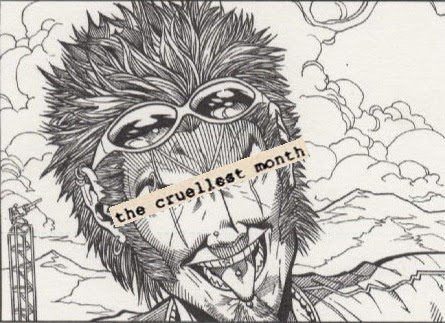
Not only the title, but the underlying ideas and structure were inspired by The Waste Land by TS Eliot. The quotes were heavyhanded at times, forced at others... usually, the poem was meant to sit underneath the project or in the back of my head as I wrote. I honestly can’t remember what spurred the connection. Sometime in March, I was thinking about Uncanny X-Men #394 and the poem and something clicked and I went for it. The entire month-long project was not meant to be a replication of Another View despite being in the same mould. It was a bit more serialised, a bit more freeform. The eventual shift into other issues from the run was unexpected/unplanned and, really, if I were to actually adhere to the structure of The Waste Land, it would have been five issues. I realised too late that doing a fifth issue, either issue 400 or the annual, would have rounded things out a little more and not left, from my perspective, a bit of a gap.

Despite my education in English literature (four years of undergrad, two of grad school), I’ve never been a big poetry person. I’m too literally minded. I struggle to think in metaphor at times. I don’t always have the patience. And, yet, I’m very quite fond of TS Eliot. “The Love Song of J. Alfred Prufrock” is my favourite poem and the first one that I encountered, which is probably a little unsurprising. Upon doing that poem in a first year class, I went out to the campus bookstore and bought a nice little Everyman’s Library Pocket Poets edition dedicated to him. “Prufrock” remains my favourite, though I’d concede there’s more to The Waste Land, obviously. Some of the connections I found as I went...

1. While I loved the title, I loved the little graphic that I made with some pencils by Ian Churchill from Uncanny X-Men #394 and a snippet from The Waste Land from a picture of one of the early printed editions. I never did go back to find where that “listen until you figure the song out” theory came from. This was a purposefully unusual (for me) to start the project.

2. The theory that Joe Casey’s work is about what comes “after” has been a personal contention for years.

3. I never saw it through, but it was here that I considered really focusing in on the influence of Casey’s Uncanny run on Grant Morrison’s New X-Men run, and the way that Casey seemed to set up a number of story/plot/character beats for Morrison. That could be a coincidence, Morrison being quite good at taking existing ideas and integrating them (like X-Corps), or even Casey aware of Morrison’s plans and foreshadowing some of them. In the end, I chose to shy away from an in-depth comparison, preferring allusions and snarky insinuations that Morrison ripped off Casey, because that amused me.

4. Karl Jirgens.

5. Aside from attacking Cape Citadel, I was struck by how little similarities between Uncanny X-Men #394 and The X-Men #1 actually were present. Given the time period, unless Casey had a copy of the first X-Men Marvel Masterworks, there was a very good chance he had no actual reference material to that comic. He had the equivalent of what Warp Savant has: a new report/summary of events taken from a distant point. Casey seems to use the very broad framework of the idea of Magneto attacking the base and goes from there.

6. Most of the quotes from Casey or anecdotes about the making of the run were taken from his newsletter. In the lead-up to Weapon X-Men, he did a multi-part breakdown of his run, going issue by issue (or by chunks) to give some context and insight – and backwards perspective. He’s pretty honest about the run’s failings and I’d say a bit too hard on himself. Despite the good humour he writes the ‘recolleXions’ with, you can tell that this run is still a sore spot, both creatively and professionally. It was a pretty spectacular failure on both fronts. An interesting failure, I’ve long contended and full of more depth than people give it credit. After a while, I gave probably a bit too much attention to advocating for it, I suppose.

7. Casey mentioned the ‘penis arm’ on Wolverine on the cover and I’m not sure if I’ve ever quite seen it. I think I have?

8. Logan is kind of a shitty dude in this issue.

9. The inclusion of Warren in the first issue was a bit fortuitous and possibly an indication of some ideas bubbling under the surface for Casey. I think I found some compelling reasons for his inclusion – his past crush on Jean was one of those ideas that I thought of as I was writing the piece.

10. It’s definitely possible that Unreal City was the connecting point between the comic and the poem. Unfortunately, the label on the fence is City Hell. I wish my note for 5 was something I thought of to include here. Alas...

11. Was Warp Savant Bugs Bunny or more like Daffy Duck? I mentioned Bugs because of the kiss, but Daffy was always the more antagonistic of the two. If you had to pick a ‘villain,’ that you root for in Looney Tunes, it’s Daffy Duck. Later, when I made this reference again, I made sure to include Daffy as a result.

12. Whenever I’ve done a project like this, there inevitably comes the piece where I think I’ve completely wasted the day. By the end, there are several. This was the first one. It’s not only that my mindset is so far removed from these hypothetical new readers, it’s that I don’t respect the concept. I can’t even pretend. I set myself up for failure – and wound up making a point that I thought was much needed about the issue. There have been too many movies at this point for anyone to care, but the idea of making comics to appeal to ‘regular’ folks who saw the movies was such a prevalent idea at one point and it always frustrated/infuriated/disgusted me. I grew up with comics in my house and was a newsstand kid who’d pick up whatever looked interesting. I always followed along just fine. These ideas are, at their core, insulting. They assume that non-comics readers are too stupid to understand most comics and that most comics are too impenetrable for non-comics readers. It’s basically a “comics suck, but people are too stupid to get them anyway” mentality that I never understood. You literally didn’t need to have read any past X-Men comic to understand Uncanny X-Men #394. Liking it was a whole other idea...

13. “starless inscrutable hour” is from “Whoroscope” by Samuel Beckett. On the bookshelf next to my bed, right near my pillow, I have the four volume Grove Centenary Edition of the complete Beckett, edited by Paul Auster. While waiting for my wife to get ready for bed, I often pick up volumes and I had picked up the fourth volume some time before this piece, which contains the poems, short fiction, and criticism. “Whoroscope” is a poem clearly influenced by The Waste Land and seemed like a suitable place to take the title as I jumped to a new issue. I had the idea for a few days before doing so and I think the twelfth edition pushed me over the edge to do it. It meant finding a suitable line to use for the title, a suitable image, and to do another graphic. I don’t recall if I knew right then that I would do more than this. I don’t believe so. I remember wanting to discuss Chamber since he was, initially, a big part of Casey’s conception of what his X-Men run would be about... and, then, he wasn’t...

14. I always thought Chamber was from Australia for some reason. He’s actually British.

15. I tried to address issue titles, but found them oddly worthless (aside from “Rocktopia Part 8 of 5” of course). I worked in the title to issue 395 in this piece rather hamfisted. I did like the idea of mutants as God’s nepobabies as the real reason why they’re so hated.
16. 


17. I don’t like the title “Playing God.” I don’t think it suits the issue at all. I tried to make it work. What I never found a place for and did want to discuss at some point was the title page of the issue. I really hate that page. The text choices and layout are both terrible. The visuals are fine with the blood cells making a double helix and the little circle headshots. But, the title over the X-Men logo followed by the combining the name/bio of each character with a creative credit was clunky and confusing. Easily the worst part of the comic.

18. The Waste Land lines 128-130.

19. “Whoroscope” lines 66-67.

20. Part IV of “The Waste Land: FiveLimericks” by Wendy Cope. I was oddly proud of the idea of discussing the influence of Chris Claremont on these issues by rewriting parts of the poems that I took the titles from. At whatever point I decided to do more than the two issues, I went looking for further Waste Land-influenced poems and came across Cope’s Limericks, where she does five limericks, summarising each part of The Waste Land. Hilarious and clever, I love them. “In April one seldom feels cheerful;” is how she begins the first Limerick, so it seemed like a natural choice to play off “April is the cruellest month.” The text over the eyes was harder to find here and was taken from some project where people wrote out poems by hand. Sizing was an issue, but I figured, by this point, clarity wasn’t essential.

21. Settling old business.

22. I was initially unimpressed with Warren’s speech and this piece was me talking myself into thinking it was actually really clever and well done.

23. Why Adventures of Superman #612 and the rest of Casey’s final year on the book matters so much.

24. I shied away from Jean’s privilege and the ways that she may or may not encourage Logan’s feelings towards her. I had a paragraph half-written that touched on the Susan Richards/Namor thing, too, another trope that I’ve always hated. I took it out because it didn’t feel right, particularly in what happens this issue – and how the issues between her and Scott actually play out in New X-Men.

25. I was never prouder than discovering the line “April is the coolest month” in “The Waste Land” by John Beer. His poem is part parody, part sequel, part its own thing. It’s much larger and funnier than Eliot’s poem. I couldn’t find a great image for the text, so I highlighted it and used that, giving the fourth graphic a bit of a pop. I really do love the title “Rocktopia Part 8 of 5,” but discovered something odd: when Casey wrote about the issue in his newsletter, he referred to it as “Rocktopia Part 5 of 8,” and had a picture from the comic showing that. I had to doublecheck the issue for myself and mine shows 8 of 5. I think that I gave a pretty good explanation for the numbering, too. 8 of 5 is far superior. I guess it was meant to be 5 of 8 and was corrected after the fact or someone changed it thinking the numbering was a mistake, and Casey doesn’t remember the original.


26. Jack Kirby and Sean Phillips, fuck yeah.

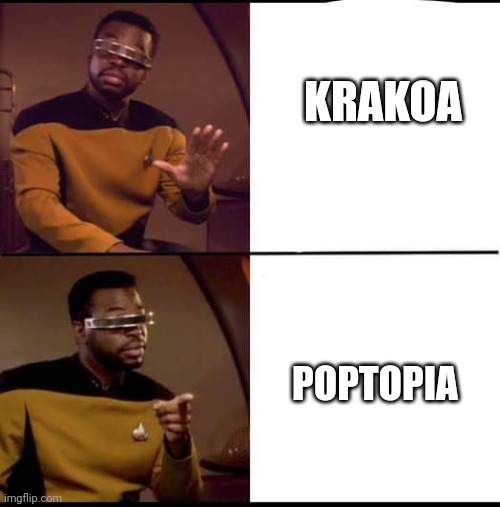
27. I fully intended to push the idea of Nightcrawler as the mutant missionary in Casey’s run and the way it prefigured his role in Krakoa and it never felt right.

28a. The Waste Land lines 27-30.

28b. The Waste Land lines 108-110.

28c. The Waste Land lines 301-302.

28d. The Waste Land lines 385-390.

The idea of doing a single post jumping between the four came earlier and it seemed like a logistical nightmare to pull off well if kept in a single post. Doing four posts, all with the same number, based around a singular theme was much better. I wrote these somewhat as a single piece, albeit more like parts of a single piece. As always, I ignore the art and that seemed like a logical place to bring the four issues/titles together, particularly under the argument of how the art impacted the idea and execution of Casey’s run. Ian Churchill is so associated with the run, but he didn’t do three full issues. Ron Garney only did two. Sean Phillips did the most and, yet, he’s not really thought of as the artist of this run for obvious reasons.

29. I used the term ‘comicbooks’ throughout the project, because that’s Casey’s preferred way to write it. The idea that this run was actually part of a larger tapestry/tradition came late, well after the idea that it was the precursor to Krakoa in many ways. I almost leaned into that idea hard, but eased off for whatever reason. I referred in passing at some point to misquoted lyrics because Warp Savant quotes from the song “Black Diamond” by Kiss (off their eponymous debut) but gets words wrong. He sings “Darkness will fall on the city... seems to fall on you, too,” but the lyrics is “seems to follow you, too.” I debated writing about that for an edition at one point. It seemed a little unseemly to focus on Casey shoving in a line from another piece of art somewhat randomly and incorrectly...

I don’t know if this piece – or the project as a whole – works. It did what it need to for me. But line 252 from The Waste Land does sum it up nicely.

Tuesday, April 29, 2025

the cruellest month 29

X-Men comicbooks are about X-Men comicbooks are about superhero comicbooks. Uncanny X-Men #394 is an X-Men comicbook and a superhero comicbook and a Joe Casey comicbook and an Ian Churchill comicbook and. The intersection of multiple. The shadow of Claremont and the shadow for Hickman. Another brick in the wall. Modernist and postmodernist and oh what’s the difference anyway. Did I? Did it?  Too cruel, too cool.

A perfect piece of popart that speaks to me because the process of creating the comicbook is the process of reading the comicbook. “Reading and rereading and pondering and rereading and pondering on and on for decades has not been an effective process, so I will attempt to write my way into insight. All of my best ideas come at the keyboard.” Go in with a vague idea, sit down, bang away, come away with a chunk of something and keep going until you get somewhere. Casey kept writing until he figured it out; I’ve kept writing until I figured it out. Did I? Have we arrived at the elusive insight? And so, declarative statements:

Uncanny X-Men #394 was a misstep. Uncanny X-Men #394 was a mismatch. Uncanny X-Men #394 was a misfire. Uncanny X-Men #394 was not a mistake. Uncanny X-Men #394 was not a mistake. Uncanny X-Men #394 was not a mistake.

You can’t just reach in and pluck these comicbooks out, you know. You may or may not have read them, but they’re part of the linear progression of the comicbook. Davis, Claremont, Casey, Austen... you don’t get one without the one before. And so it goes until you eventually land upon Hickman or Gillen or whomever and you don’t get there without here. You don’t get Quentin Quire without Warp Savant. You don’t get Hickman mutant economics without Casey mutant economics. The emphasis in Uncanny X-Men #394 is on interpersonal soap opera, because that’s what matters. It doesn’t matter that Casey wouldn’t continue that particular soap opera subplot, because it’s a river and you jump in, you jump out. I must have mentioned somewhere why I love taking the bus (aside from its cheap convenience): the bus does not care about you. There’s no monetary privilege of a cab or an Uber where you take me where I want because I pay you. The bus does its route and how many people get on and off does not matter because the bus does its route. Mainstream franchise superhero comicbooks are the bus. Casey got on the bus at stop 394, got off at stop 409, and it kept going. Not everyone understands that they’re riding a bus when they take on a project like this. Casey understands. He drops the Scott/Jean/Logan stuff into his issue and never touches it again, left for another passenger. He leaves a Nightcrawler plot behind, on the seat, purposefully. He gets it.

Uncanny X-Men #394 prefigures “Rocktopia Part 8 of 5” by being a single issue. Decidedly not for the trade. It is in the Poptopia trade, because I own that. It and issue 399 sit somewhat awkwardly on either side of the four-issue storyarc, settling into a typically-sized six issue package that doesn’t end neatly or nicely. Casey tries to be commercial, because it’s his career and he wants to have it last and make money to live and pay bills and all of that... but the dude cannot help himself. It’s a constant push and pull with him. Take the big gig, have no real desire for it. Need to kick it off with a bang, don’t use any of your book’s characters. Get paired with the flashy artist, deliver mopey shoegaze scripts.

You know Reveal? Sure y’do. If you know Casey and Sean Phillips, then you know Reveal, because it has “Autopilot” in it, the short comicbook stab at autobiographical fiction by Casey. Each of his three major gigs from this period get a page with Phillips going all out with visual allusions. And I quote:

The FIRST movie was successful. The SOURCE MATERIAL, on the other hand...

It’s the big FRANCHISE team. The heavyweight champs. Another rung on the career ladder...

Okay, you admit... there are some underlying ANALOGIES involved that interest you. The FREAKS who inherit the Earth. The OUTCASTS that find solace amongst themselves. What was UGLY has become BEAUTIFUL.

Whatever.

They offered you the gig. You took it. You did your job. Big sales. Big royalties. Big heat. Okay, not your BEST work, but you don’t regret these things when you’ve just bought a HOUSE...

You think it MEANS something to work on the top-selling franchise. You think you’ll feel DIFFERENT...

...until you GET there and discover the editorial office is more CONFUSED than the thirty years of FICTIONAL CONTINUITY you don’t really want to reference anyway. You’ve got your OWN convoluted continuity to deal with...

Typical, in its way. That final paragraph/caption rings false, to me. Casey reveled in referencing “the thirty years of FICTIONAL CONTINUITY.” He loves that shit. He began his run by referencing the oldest bit of continuity, going back nearly FORTY years to do so. One of the big visual beats is an allusion to the first cover. As I always round my way back to: Wizard named him the next Kurt Busiek for a reason. Hell, he’s been annotating his current Weapon X-Men series in his newsletter with the various references he’s managed to pack in. There’s a bit of know-it-all punk kid to this impulse. That “look at what I’ve read” sort of thing. Certainly nothing that I relate to. Let us go then, you and I...

Warp Savant – Warps Avant

Casey does a great little verbal bookending to his run. Issue 394 ends with Cyclops saying, “LET MOVE, PEOPLE. / NO ONE EVER CHANGED THE WORLD BY JUST STANDING AROUND...” Issue 409 ends with Wolverine saying, “LIKE, I SAID, PAL... IT’S A NEW WORLD. / WE’VE CHANGED IT MORE THAN ONCE. WE’LL CHANGE IT AGAIN.” Change or die. That’s all Warp Savant is trying to do. Change something. Change himself. Change his world. Sometimes, you do that by giving it a kiss on the head before you disassemble it. Sometimes, you do that by taking away the toys. He removes some weapons of death and destruction; Warren Worthington III removes some chemicals of death and destruction. Why is one acceptable and the other not? There’s a certain privileged hypocrisy baked into superhero comicbooks – and X-Men ones in particular. A sense of superiority, not of mutants over humans... Xavier mutants over non-Xavier mutants. It’s about the school, the club, the team... when you’re in, you can do as you wish; when you’re out, you’re cannon fodder. You ask some and they’ll say to dismantle the military base and let the drugs flow freely. They don’t know what the master of them that do did, if you jump ahead to your Gillen and Xavier keeps the world on even keel. In a comicbook about evolution and survival of the fittest, there’s a certain tribalism, a certain might makes right at the heart. No one sees them as evil...

I’M A MUTANT AND I’M EVIL!

That youthful rebellion masquerading as nihilism. Pure id, pure Bugs Bunny and Daffy Duck... putting the comic in comicbook. It’s traditional is what it is, going back to the beginning when men were men and villains were evil. The old ways coming back, patterns repeat, cycles and cycles and cycles and fragments shored. Plucking ruins from the past and colliding them, hoping to find meaning...

...I haven’t solved it, of course. That was my stated goal and I’m no closer, further away, perhaps. Frustrating. Out of grasp, unable to grasp. Warp Savant doesn’t matter. It’s a little sad, because he wanted to matter. He wanted this to matter. I did. It did.

‘Well now that’s done: and I’m glad it’s over.’

Monday, April 28, 2025

the cruellest month 28

And I will show you something different from either

Your shadow at morning striding behind you

Or your shadow at evening rising to meet you;

I will show you fear in a handful of dust.

Was it Joe Casey’s fault that his Uncanny X-Men run unfurled the way it did? Paired from the onset with Ian Churchill, it never felt like a smooth pairing, one of two creatives meshing, which is a bit of a prerequisite for a comicbook to be successful on nearly any level. Unless one of the two primary members of the creative team is doing such stellar work as to compensate for the other, it’s almost impossible for a comic to really hit if there isn’t some level of harmony. While Casey would admit to his own failings when discussing Uncanny X-Men #394, I don’t think the mismatch with Churchill was as apparent in their first issue.

What’s readily apparent in Uncanny X-Men #394 is that Churchill’s strength is single images. He’s not a bad panel to panel storyteller, it’s that he really shines when he can try to hit a single, impactful visual that’s meant to arrest your attention. Flipping through the issue, almost every page has one or two panels that, taken on their own, at wonderful compositions. Usually, these images are built around a single focus. Churchill isn’t a George Perez kind of artist where you want to pack panels with tons of characters and objects. His more unsuccessful panels are where the focus is divided or there’s too much going on. The first page is practically perfect in the way each of the four panels have a single focus that he can make pop and draw your eye towards.

I think this is what Casey meant when he said that the inside of Warp Savant’s head wasn’t suited to Churchill’s skills and that he should have done a better job tailoring the script to his artist’s abilities. As written/requested, it seems like Casey wanted a chaotic realm full of random objects and subconscious tidbits, filling up every bit of every panel with details; except, Churchill’s best compositions are the ones where the background is minimal or absent. He’s so good at giving a character or two posed just right. From the cover to Cyclops’s turning to talk to Jean to Warp Savant charging into Cape Citadel or warping the general... It’s not about big panels or splashes necessarily, but really tight foci for Churchill to home in on and present in the best possible way.

For all its flaws, I think Casey gives Churchill a lot of opportunities to do that in this issue. As I said, nearly every page has a panel or two that absolutely sings. A big part of Churchill’s problem is that he appears to put too much emphasis into adding movement over the course of scenes, often by changing angles. That limits the effectiveness of panel to panel transitions, and winds up creating some awkward compositions. The page where Warp Savant does his little rant before Wolverine descends from on high is a great example with the middle panel opting for this odd angle from beneath the character before jumping to Wolverine’s perspective from above over the final two panels – both of which are quite good, particularly the transition from distant-above to closer-above perspectives. Another fantastic sequence of panels is on the second page, while in a club, Warp Savant looks at a bottle of alcohol in one panel, warps it in the next, and then keeps looking at us/the girls with an empty hand raised – all done from the same perspective with the same sized panels, it’s great, basic visual storytelling over successive images.

This issue provides a good indication of how to tailor scripts to Churchill’s strengths with a brisker-paced issue, lots of opportunities for single/dual character panels, and really simplifying the visuals requested. I don’t think Casey had enough lead time to really see that and alter his approach, nor did Churchill last on the book long enough.

Thursday, April 24, 2025

the cruellest month 24

Warp Savant is an entitled character. A young white man who uses words like “skanks” without much compunction as they seemingly hang off his every word, his entire attack on Cape Citadel is a temper tantrum disguised as rebellion. It’s an element that Grant Morrison hits harder in “Riot at Xavier’s” with Quentin Quire. What does Warp Savant seem to have to complain about? From what we see, he does what he wants, he has no problem attracting women, his mutant nature hasn’t made him a target... The brief glimpse into his life is one of privilege and comfort.

What do you do with your privilege? could be a theme of Joe Casey’s Uncanny X-Men run if you squint. It’s the progression of the run, I’d argue, and it does begin with Warp Savant and the X-Men in Uncanny X-Men #394.

Warp Savant uses his privilege to do whatever he wants for his own selfish reasons. It’s all id and whims and thoughtlessness. He evokes childishness with the mimicry of Bugs Bunny and the way he misquotes song lyrics. Even his introduction: alone, in a room with a computer. When he’s in the club with three women, he sits apart, barely wants to engage with them. He doesn’t even drink alcohol that we see, he just absorbs it with his powers. He’s playing at a certain image – he copies Magneto because he can’t actually think of anything his own. All he does is take, take, take, and cares little for anyone else.

Warren Worthington III expressing some sign of recognition in Warp Savant at the end of the issue is the smallest glimpse into what the run would eventually become. Worthington, despite his history with his wings, Apocalypse, and becoming Archangel, is also a man of privilege. We normally view him exclusively through the lens of his wings and blue skin despite his mutant abilities actually taking a back seat to his true source of power. Aside from the odd reference or brief glimpse, his immense wealth is rarely harnessed for any greater good or something beyond himself. What does Warp Savant live for? What does Warren?

You can extend this into the ‘interpersonal soap opera’ element of issue 394. Scott and Logan have their privileged positions. Scott, in the aftermath, of his possession at the hands of Apocalypse is taking his entire life for granted, to an extent, particularly his relationship with his wife. His coldness is partly an expression of who he is and what he’s feeling, but it’s also predicated on the knowledge that he can. He can be a distant, cold husband, and he’s relying on Jean to deal with it. The way that he emphasises the word ‘wife’ indicates how much he’s relying on the formalisation of their roles in their relationship to maintain the status quo that he’s also pushing against as he sees fit.

Logan, seeing this distance, tries to take advantage, taking for granted the idea that, if it weren’t for Scott, Jean would be with him. He has no problem, when the situation suits him, to acting as if her attraction to him is automatic and only limited by her wedding vows, like some technicality that she wishes weren’t there. When he kisses her and they seemingly face death, it’s his acting on this sense of entitlement, as if he’s owed that if he’s going to cease to exist. It wouldn’t be right for him to no longer be and not have Jean, an attitude that doesn’t end when they don’t die. There’s always a presumption, similar to Scott’s, that Jean is his on some level.

Warp Savant’s ‘death’ at the end is another act of privilege. Faced with the consequences of his actions, he chooses to avoid them – or control them, at minimum. We don’t know if he dies or what actually becomes of him. If he doesn’t die and, instead, lives in his own bubble world, then he basically opts out of consequences for a reality where he’s his own god. After all, his powers are based on the idea of control and overwhelming power over anything he chooses. It’s a lesson that, however subtle and seemingly unrelated, Warren learns from...

Friday, April 18, 2025

the cruellest month 18

O O O O that Claremontean Rag—

It’s so uncanny

So x-treme

We, ah, reach that awkward point in this improvisation where I admit that the work of Chris Claremont is a bit of a blind spot for me. I’ve read some, barely scratched the surface. Mostly via a subscription I had as a kid one year for X-Men Classic, the reprint series for X-Men ala Marvel Tales for Spider-Man. The bit that I had covered Uncanny X-Men #189-200, which is a helluva run. John Romita, Jr. young and energetic, Xavier in leather and fishnets, Nimrod roaming the subways, Magneto on trial... I don’t remember a lot, bits and pieces. Some other X-Men comics here and there. Had a black and white mass market paperback reprint of a two-parter with Arcade and some other issues, too. Never went back and read the whole thing. It’s so big, so influential, that you don’t need to experience it directly. And, in my experience, when you do, it’s a letdown due to just how many folks ripped it off.

Warp Savant is a pure Joe Casey character. That gleeful embrace of villainy, that energetic youthful disregard for maturity and authority, those misremembered song lyrics... But, he’s also a character in an X-Men comicbook and he owes some of his elements to Chris Claremont because they all do. It may just be the leather jacket and mesh tank top, that youthful club look straight out of a punk fetish magazine. He looks like he should be hanging with the Morlocks or be a Hound from the future. His M face tattoo is taken from Bishop. He’s every seedy kink from that run except utterly sexless at the same time. A pale imitation of that Claremontean character type that we’re all vaguely familiar with, using a plan that the original X-Men villain tried and failed at decades earlier (or however long in continuity). Walking X-Men comicbook mishmash, a refugee from continuity and canon. There’s a mysterious element to Warp Savant that feels like the bad, rotting influence of Claremont. A villain that appears from nowhere, no past, no clear motive... just fucking shit up and disappears without a trace. We don’t know he died. He’d probably come back as another lost Summers brother.

His name has long vexed me. I know we’re at the point in superhero comicbook history where there’s a premium on original names as, let’s be honest, were it not for copyright law, you’d have a ton of Supermans and Megamans and Ultramans and so on running around. On some level, I don’t think it’s a coincidence that Casey was in the middle of his Wildcats work and chose to use the word ‘Savant’ in the name of a new mutant character given that Claremont is the co-creator of the character Savant from way back in WildC.A.T.S. #11. A small, subtle connection – though, how subtle, really? How many Savants are there running around the worlds of superhero comicbooks? Throw it all in the pot.

X-Men comicbooks are about X-Men comicbooks.

Poptopia.

It’s not a bad thing, by the way. If you looked across the hall, you would’ve saw Grant Morrison doing similar things. Using and reusing old ideas in new ways. Self-referential, deep cuts for the true fans, and unable to escape the insulated bubble world. It’s like Warp Savant casts a spell here, brings us all inside his head canon with him. The shifting, mixed up world of X-Men comicbooks where you’ve already read them all and the details seem familiar yet fresh. Chris Claremont as a genre. Casey taps into the first bit of soap opera from Claremont’s time with the characters, finally delivering on it, only to explain it away as a half-remembered dream, basically.

“DO YOUR RESEARCH...” Warp Savant advises Jean when she uses telekinesis to knock him down but not out. It’s a warning, a bit of friendly advice from the ‘next Kurt Busiek’ per Wizard. Casey’s Marvel career to this point had been bad rush jobs or comics peppered with continuity minutia for the True Believers out there. He may have been more of an Avengers guy, but even he had a passing familiarity with the X-Men. Enough to understand its roots and the major figure that looms over the characters. Hell, he was displacing him by taking over Uncanny X-Men given the way that Claremont’s long-heralded return flopped with readers. He still had his fans and those that got what he was laying down (I’m in the tank for Jim Starlin, similarly), enough to warrant his own new X-Men series... but not enough to headline.

But... he... is... inescapable...

Did people want more Claremont? Was it even possible to not give that to them? As I said, you could make a very good argument that Morrison did the same thing, but they managed to make it seem fresh enough to, somehow, win readers over. Joss Whedon would do something similar with Astonishing X-Men eventually. How many ‘definitive’ runs can a superhero comicbook have? At what point does the assumed supremacy become the actual supremacy in effect? You can call Casey’s run a failure (and he’d most likely agree), but how many succeeded? After Claremont’s departure, it chewed folks up and spit them out... including Claremont himself...

All that remains is a scene where all of the X-Men have Chris Claremont’s face, saying nothing but CLAREMONT...

Son of man,

You cannot say, or guess, for you know only

A heap of broken images, where the sun beats,

And the dead tree gives no shelter

Thursday, April 17, 2025

the cruellest month 17

“Ahhhh, Poptopia... I remember being more jazzed about the story titles than I was about the actual story, as it ultimately played out.” And what a title it is, Joe; a title that seems to encompass everything about this run on Uncanny X-Men. A thought experiment of culture and comicbooks and the ‘real’ world all smashed together in a little bubble. As the refrain goes X-Men comicbooks are about X-Men comicbooks and so too Poptopia. You could call Uncanny X-Men #394 “Poptopia Part Zero” rather than “Playing God,” if you wanted to be a bit more on the nose regarding its place within the run, both thematically and literally. Despite the fact that the issue is an outlier in its cast and plot, call it a prelude, a prologue, an introduction, an overture... It sets the stage for all that follows, setting out the big ideas under ten tons of interpersonal soap opera.

But... who is “Playing God” exactly?

Presumably, we’re meant to think it’s Warp Savant as he invades the Cape Citadel and uses his powers to absorb the various soldiers and X-Men he encounters along the way. Deciding who lives, who dies, who gets teleported inside his head. There isn’t much to that, though. It’s all kind of laid bare right there. “Evil mutant runs amok playing god” is so ho hum. By that same token, it’s a little dull to say it’s the X-Men, as a group or as individuals. Cyclops taking up the role of Xavier, to a degree, puts himself in the position of the moral authority on the actions of mutants. He decides what is and is not acceptable. Meanwhile, Wolverine is the sort to maim and kill as he sees fit. When he dives from an airplane, claws popped and arms extended toward Warp Savant, what do we think his intention was? Like Warp Savant, that willingness to kill, to choose who lives and who dies, is a fairly basic definition of the concept. None of them truly live up to it.

You could go ‘meta’ and say that it’s Joe Casey. As writer, he decides everything about the comicbook. He writes the script that is then executed/interpreted by several other collaborators. None of the character decide that anyone lives or dies in their world... Casey does. There is no free will in fiction, it’s all determined by the writer, even if their method is one where the characters seem to ‘write themselves.’ Superhero comicbooks in shared universes for the big publishers provide an interesting case of this as there is no singular God, but a rotating, changing cast that ‘plays’ God in a sense, filling the role for a time until they no longer do. The title could be Casey’s recognition of his place within the creative hierarchy, an acknowledgement of his eventual ousting from this work-for-hire gig, supplanted eventually by Chuck Austen just as he supplanted Chris Claremont. This definition plays around with a bit of the metagames that Casey is playing in his run where the repetition of certain broad plot concepts represents his place in the long succession of creatives who preceded him – and will follow. Might as well called it “Rearranging Deckchairs on the Titanic” if that’s the case. A suitable possibility... or part of the answer?

Let’s return to Warp Savant... Yes, I already discounted him as the eponymous deity gamer due to the blasé nature of piggybacking off the lives/dies nature of his powers. I tend to prefer a definition of “playing God” that extends beyond the binary of alive and dead. That’s flipping a light switch, people, not acting as the creator of the universe. Except, that’s not exactly what Warp Savant’s powers do, is it? He doesn’t kill people. He doesn’t kill at all. He transports matter from one world to another. The inside of his head is an alternate reality of his own creation. He does not have total conscious control over it – or any control – and that does not matter. It is his world full of people and objects that he chooses to place inside it. He creates a landscape that may or may not change depending on his whims. And what makes up his little world? The esoterica, the random matter that he encounters. There is no purpose, no rhyme, no reason. It’s all whims and chance. A collection of information with a hint of curation. He takes from the world to make his world.

Earlier this month, I compared his powers to the accumulation of knowledge that comicbook fans have. The piles of continuity that create each personal head canon. That’s all Warp Savant is doing: head canon. He takes what he wants, ignores what he doesn’t. And the resulting world is far from perfect, patched together from the randomness. To paraphrase a literal genius, “His utopia is more of a Poptopia.”

And, at the end of the issue, he goes into that Poptopia himself, no one seems to care, no one notices, everything returns back to interpersonal soap opera because X-Men comicbooks are about X-Men comicbooks. That’s all they are, you know?

Wednesday, April 16, 2025

the cruellest month 16

But, you know, let’s talk about those final two pages of Uncanny X-Men #394, because they’ve kinda been bugging me. To set the scene: his powers turned off, Warp Savant is badly hurt, Cyclops is pissed, Jean and Logan nearly die but show back up in the real world, and, as Wolverine is about to, presumably, kill (or maim severely) Warp Savant, the kid uses his powers on himself. This mostly gets a response of “Who the fuck cares?” and the issue quickly shifts the emphasis to Jean and Logan’s kiss inside Warp Savant’s head as everyone just goes home, job... done. There’s a jaded cynicism at play here that feeds into Joe Casey’s conception of the X-Men in the real world. This is a job that they take very seriously, but this is also some punk teenager who caused a messed and quit and who cares let’s go get some drinks boys.

Warp Savant’s assault on Cape Citadel is, seemingly, meaningful and important to him. This is the culmination of his life to this point. He’s finally an adult and has decided to make sure the world knows he exists and here come to X-Men to let him know that no one gives a shit. You fall in line or you get gone, they don’t actually care either way that much because they have much bigger concerns (image, press, kissing).

The inherent criticism of the X-Men here is that by growing to the scale that they have, they become insular and uncaring to anything outside of their walls. They only see Warp Savant’s actions as it relates to mutants, their purview, specifically how it plays from a public relations perspective. Cyclops begins the issue focused on how the media discusses mutants and what that means. Perhaps, the real battle is there...? But, there’s almost an element of autopilot in how they proceed. The reaction is automatic and swift, yet barely considered. The X-Men are a system, a machine that received stimuli and activates. Attack the evil mutant, engage interpersonal soap opera... X-Men comicbooks are about X-Men comicbooks... It's like there’s a flow chart at work. Is it a mutant (Y/N)? Is it a good mutant (Y/N)? Can the evil mutant be redeemed (Y/N)? Is the evil mutant threat over (Y/N)? Follow the chart, hit the end result: Y mutant, N good, N redeemed, Y threat over, result: return to base, mission accomplished, resume interpersonal soap opera.

Warp Savant is something is a non-entity to them beyond the actions he is immediately taking. He’s not actually a person. He’s a mutant, subclassified evil. The sinister undercurrent on display throughout the issue, in particular those finals pages, is unavoidable. It’s not a conscious decision by any of the characters to not care, it comes naturally to them under the guise of practicality and more important concerns. The idea that the ‘good guys’ don’t care about the death of someone that they are ostensibly charged with protecting, even from themselves, is a bit jarring.

As Casey was already in the midst of his Wildcats run, he had already begun to explore the idea of corporate superheroes and even a superhero corporation. That’s the mentality that he brings to the X-Men. It’s not the lovable mutant family good time comicbook that fans were accustomed to. It’s the workplace office drama. All monitoring press releases and managing situations and who doesn’t maintain a healthy work/life balance (hint: it’s Cyclops). Warp Savant is thrust into that world, making a definitive statement that he wants nothing to do with it. He attacks Cape Citadel partly to follow in Magneto’s footsteps, but also because it is the ultimate symbol of the western power structure. Post-childhood, there are generally four paths that may overlap: more school, get a job, join the military, or start a family. As Warp Savant attacks the idea of giving himself over the concept of patriarchal nationalism, he’s attacked by a group that’s come to inhabit the other three options all in one. School, family, career... you can have them all at Xavier’s!

More than that, the business of the X-Men is military in nature. What’s sent to ‘handle’ the Warp Savant situation isn’t so much a group of office drones as a special ops team. The shot of Archangel arriving on the scene looks like he could be part of some secret branch of the military that deals with superpowered threats, wielding a weapon that looks like military tech. By growing to encompass school family, work, military, the X-Men have also become an ideological cause bordering on a religion. A movement that demands complete fealty to the cause – a cause that eventually absorbs all criticism, all opposition. Am I saying that Casey prefigured Hickman? Forget Krakoa, join Poptopia.

Saturday, April 12, 2025

the cruellest month 12

A thought exercise (that I’m not sure I’m capable of)

Imagine: You are a brand new superhero comicbook reader. It is 2001. You saw X-Men in theatres the year before. You’re walking down the street. You pass by a comics shop, see a poster for the new X-Men comics by Joe Casey, Grant Morrison, Ian Churchill, and Frank Quitely. It’s maybe even a poster featuring Quitely’s take on the characters where they’re standing on the steps of a memorial for humanity, Xavier up front, the yellow of the Xs on their jackets brightening things up, Wolverine’s chest exposed even more than Emma Frost’s. Something about the image catches your eye, so you go in, and you ask for the X-Men comic from the poster. The guy behind the register says that that specific comic hasn’t started yet, but it’s launching aside another X-Men run, and the first issue of that comic just came out. He grabs you a copy of Uncanny X-Men #394 and the cover immediately seems somewhat familiar. You remember Wolverine and that redheaded woman must be... Jane? She was with the guy with the glasses. You pay your $2.25 USD ($3.50 in Canada!), take it home, and, later, give it a read.

Question: What do you, as this hypothetical reader, think about this comicbook?

Assumptions: You understand how to read comicbooks. You may have read some when you were a kid or you read newspaper comic strips. Basic comprehension of words, pictures, and the proper flow of the comic are not an issue. Your only experience with the X-Men, though, was the movie.

Answer 1: You enjoy it. The villain is a bit strange, but in a fun, energetic way. You like that the issue mostly focused on Cyclops, Wolverine, and Jean (her name is Jean, not Jane! you mentally chastise yourself) because you know those characters. The situation reminded you of the movie. The art made the characters look familiar and the way that things melted by the powers of Warp Savant was cool-looking. The blue guy with wings was kinda cool, too. If you remember, you may pick up another one.

Likelihood: Eh, maybe?

Answer 2: You don’t enjoy it. The villain is just an 18-year old punk trying to do what exactly? You like that the issue mostly focused on Cyclops, Wolverine, and Jean (her name is Jean, not Jane! you mentally chastise yourself) because you know those characters. The situation reminded you of the movie. The art, while fine, didn’t look like the poster in the window. Where was Professor X and Magneto? The bad guy mentioned Magneto, but wasn’t Magneto in this comicbook? Isn’t he the X-Men’s bad guy? And was the blue guy with wings the same blue guy in the poster? That one looked more like an animal. Can this guy turn himself into animals? Is that why he has wings? You probably won’t pick up another one.

Likelihood: More likely.

Solution: I’m finding it hard to put myself in this position. I’ve literally been reading comicbooks since before I could read. They were always there. But, setting aside comicbooks, I’m not sure I find it possible, myself, to enter into anything this fresh. Everything has some set expectation or point of reference. I can’t picture picking up something like a comicbook and treating it in this way, yet that’s precisely how people talk about them. And I know it happens because I’ve seen the anecdotes from retailers. People are just this uninformed walking into comicbook shops sometimes, doing so on a whim because they saw a poster and remembered a movie, and I don’t understand it. I don’t quite buy it. I’ve never seen the point of chasing that sort of person. It’s like hearing that, according to research, when people really liked a television show, they apparently only actually tuned in for one in three episodes. I don’t understand that mentality. And I’m not sure Joe Casey does either. Sure, he put on his ‘marketing hat’ to have Logan and Jean make out on the cover (and inside), but this doesn’t read like a comicbook aimed at new readers. It feels like that’s just a disguise or an excuse or a vague hope that he never believed possible. If this comicbook ever feels ‘phoned in’ or lacking, it’s in the conviction that it would ever convert some random person into being a steady reader of Uncanny X-Men. I don’t think Marvel ever did either. Do you know how I know? Flip through the issue and notice the big ads for New X-Men that aren’t there. Or the editorial pages hyping up this new era that also aren’t there. Nothing about this suggests that there’s a world of X-Men outside of this issue beyond the implication of the issue number and the tiny caption at the bottom of the last panel on the final page that says “next: poptopia” like that’s supposed to mean anything. The only people who would pick this up and understand what’s going on in the context outside of the actual issue are existing readers. That is the target audience, always. Always. The closest to a window into other comics outside of this one is the Bullpen Bulletins page that has a list of comics out the following week and four pages of unlettered art for X-Treme X-Men #1 (out the following week). No context, no indication of what relationship those X-Men have to these ones. This was never new-reader-friendly and it was never meant to be.

Conclusion: I was not capable.

Friday, April 11, 2025

the cruellest month 11

Unreal City

Under the brown fog of a winter noon

An area of Uncanny X-Men #394 that I’ve been pondering well before I ever conceived of this examination of the issue is Warp Savant’s powers and his methodology in attacking the Cape Citadel military base. His powers have always been like an itch that I can’t scratch, mostly in how it relates to Magneto, The X-Men #1, and the entire concept of reliving that moment in time. The ability to teleport/absorb matter inside his head isn’t akin to magnetism at all and it’s always kind of bugged me. Okay, I know, I know, the answer is that Joe Casey thought the idea was cool and there was no deeper meaning. But that’s not how we play ball here, my friend. Yesterday, I compared his powers to the absorption of random comicbook knowledge by hardcore fans and his attack as a declaration of adulthood. In the literal sense of what he says and does, though, I’m curious what we can find...

The issue opens with the caption “THEY SAY IT’S YOUR BIRTHDAY...” and Warp Savant at his computer, smoking. When he comes across a Daily Bugle article about Magnet’s attack on Cape Citadel, he leans forward, eyes wide, big grin, and says, “SWEET.” The next night, he’s at a club and tells some girls that “COME TOMORROW... / ...I’M GONNA BE CELEBRATING. / BIG TIME.” In the club, he seems bored. The three scantily-clad girls barely cause him to react. He absorbs a bottle of beer using his powers. What effect does that have on him? He’s bored with his life. He’s been sitting on these powers and while his scene thinks he’s cool, he’s stagnating.

The attack on Cape Citadel reads more like a Looney Tunes cartoon than anything. He comes in, begins absorbing everything, yelling stuff like “OUT COME THE FREAKS! AND WAR’S NEXT ON THE AGENDA! / I’M A MUTANT AND I’M EVIL!” His response to a clichéd general (spouting phrases like “What’s your major malfunction?”) is to salute him, mock him, and give him a kiss on the forehead before using his powers on him. That Warp Savant seems more like Bugs Bunny than Magneto is an odd choice for Casey. It almost recalls and mocks Magneto haughty self-importance in The X-Men #1, opting to treat the entire exercise as a farce. As he continues, he muses about his motives:

THE DIRT FARMERS AND THE POLITICIANS... THEIR FEAR IS OUR GREATEST WEAPON!

IF BUCKET-HEAD WON’T SHOW HIS FACE TO TEAR IT ALL DOWN, I’LL TAKE THE HEAT, BAY-BEE!

I’LL GIVE ‘EM AN INCIDENT THAT’LL DIVIDE OPINION!

I’LL SHINE THE WORLD--!

At this point, he’s interrupted by Wolverine’s appearance from the sky. His little rant suggests he’s actually got a motive and a goal. To shock humanity? To scare them? To burn the world down? It’s hard to parse where he’s going exactly, except that, here, he’s completely in line with Magneto who never revealed his actual plan when he attacked Cape Citadel. It was the first phase of a plan to show off his power to make humanity bow before him and all mutants somehow. He never does much prior to the X-Men defeating him, similar to Warp Savant here.

One idea is that Warp Savant, by taking people inside his head, literally shows them his perspective. He’s the living embodiment of empathy in action, except the inside of his head is a war zone called City Hell (a play on Citadel) or childish nightmares. It’s all so much like a child smashing toys together. It’s interesting that only Jean and Logan seem to have true agency inside Warp Savant’s head. Maybe because they’re mutants? They understand and can navigate his world. It’s not entirely clear and Warp Savant’s all over the place behaviour doesn’t help.

Part of the problem, according to Casey, lies in his writing: “I think the imagery I was conjuring up in my mind when it came to the ‘virtual space’ where victims of Warps powers would find themselves was 1) bizarrely misguided creatively and 2) asking Ian Church to draw something that didn’t quite come naturally to him.” I think it’s refreshingly honest to take the heat completely, including absolving Churchill for not executing those parts of the issue as well as, say, Ashley Wood may have; what I’m intrigued by is the “bizarrely misguided creatively” part. I think I know what he’s getting at, yet the idea of a psychic plane where characters are transported isn’t new to an X-Men comic. What is new is how ambiguous the whole thing is with Warp Savant not actually in control of the environment in his head. It’s a shifting reflection of his inner world but outside of his direct influence.

Heading down this line of thinking, his act of seeming suicide could be an effort to ‘find himself’ now that he’s out in the world. Or is it the final act in his attempt to shock and divide? What’s truly missing and actually undercuts the issue is that Warp Savant is treated like almost nothing once he’s gone. The focus shifts to the Jean/Logan melodrama and it’s like Warp Savant was never there. Gone forever so far, which is rare in superhero comicbooks.

Thursday, April 10, 2025

the cruellest month 10

Unreal City,

Under the brown fog of a winter dawn

Now that we’re into Uncanny X-Men #394 proper and have settled on the reasoning for each of our heroes, what of our villain? Or, to be more accurate, antagonist? Warp Savant was created by Joe Casey and Ian Churchill for this issue only and has not been used since (that I’m aware). I’d pin the lack of followup on the character’s seeming death were it not for the fact that the death was far from certain and that, even if it were, since when did that ever stop anyone in the superhero comicbook game? Warp Savant’s inspiration, Magneto, has died how many times only to return after each eventually? Is it the one-note nature of the character? Again, that’s never stopped anyone. The truly unbeloved nature of this issue? Or something more central to his core?

What do we know about Warp Savant coming out of this issue? He turns 18, he’s male-presenting, he’s heavily tattooed, he wears sunglasses on his head (but never over his eyes), he likes leather pants and mesh shirts, he goes to clubs, he has the ability to teleport objects inside his own head (and seemingly prefers to imbibe alcohol that way), and he’s a Magneto fanboy. No real name, no tortured origin, no real motivation other than mindlessly striking out at the world... The inciting event for action seems to be becoming an adult. Given that mutant powers present at puberty generally, that means Warp Savant has lived with his powers for around four or so years, maybe more, maybe less, and it’s only when he’s reached adulthood that he looks to use them beyond limited means (like ‘absorbing’ beer bottles).

As much as Warp Savant patterns himself after Magneto (more on that later), he’s paired with Cyclops here, acting as the opposite to him. Cyclops’s comments about there being a world beyond the mansion walls are key; just as Cyclops is looking past the world of the school, so too is Warp Savant, leaving behind the safety of childhood and going out into the larger world, looking to make a difference in the only way that makes sense to him. Both men are looking to ‘change the world’ in their own ways (Cyclops even makes reference to this idea at the end of the issue). While Cyclops is all repression and control, Warp Savant is the opposite. He’s mindless energy, letting loose his id, and not actually acting with a plan. When he storms Cape Citadel, it’s with a vague idea of ‘shaking things up’ and no real goal. Even when he’s defeated by the X-Men, he doesn’t seem that upset. He almost seems amused, ready to go with the flow, and embrace the next step by using his powers on himself.

Visually, the two characters are related but different. Both wearing leather jackets and sunglasses (almost identical save the colour), with Warp Savant never actually putting his over his eyes, unlike Cyclops who had to keep his over his eyes or else unleash his mutant powers. Given the twinkle in Warp Savant’s eyes when he uses his powers, the eyes seem important there – maybe he can only affect what he sees. It’s these little connections...

That Warp Savant waits until he’s 18 isn’t about him leaving school entirely, either. It also puts him beyond the reach of school – beyond the reach of the X-Men. He’s no longer young enough to immediately fall under the sway of Xavier’s teachings. Not in a literal sense, because plenty of X-Men joined the team as adults (an all-new, all-different concept, one might say). Warp Savant doesn’t exist in the realm of the literal, though. He’s a walking, talking, drinking, fucking metaphor for an alternative to Xavier’s dream. Every part of the character is designed to not fit into Xavier’s school and his teachings, including his patterning his first step into the wider world on the actions of Magneto. In The X-Men #1, Magneto’s attack on Cape Citadel is just as ill-conceived and pointless. An act of terror that declared that he would answer to no one – and that’s what Warp Savant is doing. It’s a declaration of his adulthood and unwillingness to be cowed by anyone. There is no message beyond that. “I’m a mutant and an adult and I won’t be told what to do!” He strikes against one of the most potent symbols of authority in the military and has no agenda past the lashing out. Even the declaration that he’s an evil mutant is merely in response to society around him that would classify him as such, trying to provoke him to change and conform, so, instead, he owns the label.

The final thing that Warp Savant stands in for is us, the readers. Or, rather, to keep harping on it: X-Men comicbook readers (because X-Men comicbooks are about X-Men comicbooks). The issue begins with him researching continuity online and he spends the issue collecting facts inside his head. In the aftermath of the X-Men movie, there was an element of comicbook fandom that pushed back against the mainstream success, wanting to assert that that wasn’t the real X-Men and the movie fans weren’t real fans. Warp Savant is a moody geek lashing out at the world that treats him like an outcasts because he knows the continuity. Jumping from there, it's not hard to see him as a stand-in for Joe Casey (except Joe is rarely seen without sunglasses covering his eyes), a notorious continuity hound and provocateur. It’s a stretch, honestly, but I do see the character as giving some insight into the ensuing Uncanny X-Men run that, in contrast to New X-Men’s school-based location, would be about going out into the wider world and encountering ideas that challenge Xavier’s view of human/mutant relations. Warp Savant is merely the first...

Wednesday, April 09, 2025

the cruellest month 09

Why does Joe Casey decide on these four X-Men in Uncanny X-Men #394? Cyclops, Jean Grey, and Wolverine are actually pretty obvious. Aside from Professor X and Storm, they’re probably the most memorable X-Men from the movie. They also have the whole love triangle “interpersonal soap opera” plot that drives the issue and will continue, after a fashion, in Grant Morrison’s New X-Men. Moreover, as I’ve said before, Cyclops and Jean are both part of the original X-Men that fought Magneto at Cape Citadel in The X-Men #1, and Wolverine is, bar none, the most popular X-Man of all time. Those three are both essential to the story told here with no other characters able to take their place, while being incredibly well known, popular, and fit the allusion to the first X-Men comic.

That leaves Warren Worthington III aka Archangel.

There are two influencing factors in this choice: original X-Men and a member of Casey’s Uncanny X-Men cast moving forward. Setting aside Professor X, as part of this story was the X-Men being the adults and the evil mutant being the child, and they don’t look particularly adult with their teacher still bossing them around, that leaves Archangel, Beast, and Iceman. Beast is the only one of those three not part of Casey’s cast and, in fact, was a central member of the New X-Men cast, so he was out. With Iceman and Archangel to choose from, it’s tempting to call it a coin flip since Warren doesn’t actually do a lot in this issue. He shows up, fires the weapon that disrupts Warp Savant’s powers, makes a quip about living fast and dying young, and that’s it (oh, and his first panel is a great visual callback to his pose on the cover of The X-Men #1). I guess that’s it. With two natural choices, Casey just picked at random... Except...

Of the two characters, Archangel looks less human. In an issue where five mutants appear, four of them could pass for human. Sure, Logan and Warp Savant have fairly specific looks to them, and that’s all. They look human. Particularly in this new era where the X-Men costumes are leather outfits that resemble a flashy biker gang or maybe a breakdancing troupe, none of these characters pop off the page as superhuman in any way at first glance. Even Iceman only looks different from any other person when using his powers. Otherwise, he’s just as bland looking as everyone else. Warren, at least, has blue skin and wings. Of the original X-Men who are also members of the title moving forward, he’s the ‘freak’ of the bunch. He adds that otherworldly, altered element of mutants to the issue. If that was the only reason, Casey would have been better off choosing Nightcrawler, honestly, from the Uncanny cast. While not an original X-Man, Kurt Wagner is more the face of ‘freak’ X-Men and would have given Ian Churchill some fun situations with him teleporting around, firing the blaster to disrupt Warp Savant.


Warren’s presence actually relates to the “interpersonal soap opera” drama at the heart of this issue. As I keep saying, this issue is actually aimed squarely at X-Men fans despite the appearance of appealing to new readers. The superficial marketing is new-reader friendly, the true meaning is only for the hardcore. The love triangle in this issue is Scott/Jean/Logan, but, if you go back to those origin Stan Lee/Jack Kirby issues, it was Scott/Jean/Warren. Moreover, many of those initial issues had Jean showing pretty obvious affection for Scott, while he seemingly gave her the cold shoulder, partially out of obliviousness, partially nervousness, and partially because he didn’t think someone like Jean would be interested in him. Despite seeing that Jean preferred Scott, Warren, more flashy and confident than Scott, took advantage of the situation often to try and win Jean over. Eventually, when it became apparent that there was no getting between them, Warren moved on and, in a new story in Classic X-Men #1, when he sees Logan’s interest in Jean, steps in to tell him to back off. Here, he’s a reminder of both that original love triangle and that there’s no getting between Scott and Jean, because Jean cares about Scott too deeply. Casey doesn’t give any dialogue to even hint at this past, it’s all subtext for those that know. And, of course, knowing what eventually happens in New X-Men, it also confirms that Logan would not be able to get between Scott and Jean, because Jean could not be tempted away from Scott. Scott, on the other hand...

Despite these reasons, was this the best team that Casey could select for this issue? I still think that Nightcrawler might have been a better option than Archangel. It’s unusual to only see a roster of four X-Men, especially as the cast had ballooned so much over the years. With the focus on Scott/Jean/Logan, and giving enough space to Warp Savant, there isn’t much room for any other characters, so additional X-Men would have filled a similar role to Archangel: add to the fight against Warp Savant, have four or five lines, and not actually contribute much. The added subtext of Warren’s presence does a lot of the argument for his inclusion, checking off numerous boxes: original X-Man, less human looking, member of Casey’s Uncanny cast, love triangle... I guess he was the character filled with the most meaning simply by being there...

Tuesday, April 08, 2025

the cruellest month 08

In Uncanny X-Men 394, Joe Casey’s dive into “interpersonal soap opera,” as he’d later describe it, uses what would be a key point of Grant Morrison’s New X-Men, Scott and Jean’s strained relationship in the wake of his experience as the vessel for Apocalypse. In particular, highlighting Scott’s cold and distant behaviour. On the surface, he doesn’t actually seem that different given Scott’s usually reserved nature. He’s a no-nonsense kind of guy who’s settled into the leadership role of the X-Men largely because of that singular devotion to the role. Again, the depiction of Scott here isn’t aimed at new readers. It’s not even aimed at casual readers because at no point does Casey allude to the Apocalypse possession or its impact upon Scott. At best, he points towards some underlying tension between Scott and Jean, having Wolverine take advantage of it.

Except, of course, the Apocalypse possession doesn’t actually matter. While it’s an underlying cause of Scott’s behaviour here that explains why he may be acting a bit differently from his normal comicbook personality, the love triangle subplot had, largely, been dormant in the comics for quite a while. It received a hint around the marriage of Scott and Jean and that’s about it. No, what brought it to the forefront, and is where both this cover and content of this issue was aimed at new readers, is X-Men, the movie that had come out the previous year. The Scott/Jean/Logan love triangle was an element of that movie and, if you’re going to play up the soap opera for new or casual readers, taking the one soap opera element from the wildly popular movie featuring the characters was the way to go. Along with the leather outfit costume designs, this was the big influence of the movie upon the Casey/Grant Morrison era with Morrison being the one that leaned heavier into the influence of the movie. After this issue, you wouldn’t know that Casey had ever seen it from the direction he took Uncanny X-Men. For one issue only, Casey dove into the movie influence and did the work to actually set up Morrison’s New X-Men run more than his own Uncanny X-Men run.

Depicting Scott as cold, obsessed-with-the-job guy actually falls mostly on Ian Churchill’s shoulders. Casey’s dialogue without Churchill’s body language wouldn’t land quite the same way. Throughout the opening scene where Scott watches the news broadcast and, then, learns of Warp Savant’s attack on Cape Citadel, Churchill plays up two things: a sour, almost scowling facial expression and the closed off arms crossed posture. At no point does Scott’s expression or body language change. The closest we see him move is turning his hand with his arms still crossed, standing up straight, and the same scowl on his face. He looks like he hates the world around him and doesn’t want it to let any of it in. Yet, he’s watching the news broadcast and setting up the mission to Florida, because the only thing he seems to care about is his role as leader of the X-Men. In fact, the only way he engages with the outside world is through that role as he mentions to Jean that they need to remember the world outside the mansion. If he isn’t actually closed off from the world and is actually trying to put the X-Men into it, what his look and posture are actually guarding him from is Jean.

When Jean and Logan leave to confront Warp Savant, she kisses Scott’s cheek, saying “LOVE YOU, SCOTT.” Stoically, he looks ahead, arms still crossed and responds, “LOVE YOU, WIFE.” It’s a cold thing to say, depersonalising her to the specific role in their relationship, as if his loyalty is to the arrangement rather than to her. The following panel is Wolverine looking on, clearly taking in the strained marriage. Wolverine’s role in this drama is one that I’ve always found odd to give a seemingly heroic character: the other man. Given what we know about Scott’s recent history, he’s actively taking advantage of the trauma Scott went through to hit on his wife... it’s really scummy. (Wolverine, though, shortly before Scott was possessed by Apocalypse was similarly under the spell of the ancient mutant, acting as the newest incarnation of the Horseman Death, so, you could argue, that puts them on similar ground.) On the plane to Florida, there’s a brief interaction between Logan and Jean:

Logan: PROBLEMS BETWEEN YOU AND CYKE?

Jean: ...

Jean: NO. WHY DO YOU ASK?

Logan: BACK THERE... YOU TWO DIDN’T SEEM TO COZY—

Jean: JUST MIND YOUR BUSINESS, LOGAN.

It’s a quick attempt to put himself into the situation met with an equally quick rebuff, which is what you’d expect in this situation. After all, Casey isn’t looking to actually explore the love triangle idea in depth, merely reintroduce it before Morrison does with it what they wish. It’s about laying the groundwork and, after the two are absorbed into Warp Savant’s psyche and battle their way through, they find themselves seemingly about to die. Just as reality dies around them, Logan takes advantage of the opportunity to passionately kiss Jean and they seemingly blink out of existence that way. Instead, they’re returned to reality as a result of Warp Savant’s seeming suicide and Jean is left shaken, seemingly unable to recall the experience. When Logan says “I REMEMBER, JEANNIE. EVERY BIT OF IT. / JUST ANOTHER DAY ON THE JOB, EH...?” her uncertain look back at him and response of “... / RIGHT.” leaves it unclear how much she does remember of the experience. Their kiss is left as a brief moment at the edge of seeming oblivion that, possibly, only one of them remembers – and a moment that Morrison and artist Phil Jimenez would later repeat in another near-death scene in New X-Men aboard Asteroid M.

While Jean and Logan were in Warp Savant’s mind, Scott was trying to subdue the young mutant alongside Archangel and, at the moment where the final blast from the weapon that temporarily disabled his powers, Scott stands over him, gives a little speech that ends with him asking “...WHAT DID YOU DO TO MY TEAMMATES? / MORE IMPORTANTLY-- / --WHAT DID YOU DO WITH MY WIFE?!” It’s actually the same question asked twice as the only X-Men Warp Savant used his powers on were Jean and Logan. The extra emphasis on Scott’s wife reminds us that he loves and cares about her beyond his role as team leader of the X-Men. The words “more importantly” places her as his wife above her as his teammate. Yet, it also echoes his “LIFE YOU, WIFE” line from earlier in the issue. Is it love or something more possessive? More about the formality of their relationship? Does he love Jean or is he committed to their marriage as a concept despite his struggling with what he feels? When she and Logan return to the real world, his concern for her seems genuine, bordering on panic when she’s weakened/injured coming back. There’s enough ambiguity presented to play into the idea that something is amiss.

The issue leaves it as all suggestive and, as I said, for Morrison to pick up again. Jean doesn’t appear again in Uncanny X-Men as long as Casey writes it, I believe. His instincts to introduce his and Morrison’s time on the books by playing off the movie and setting up Morrison’s title shows a shrewd commercial instinct that wouldn’t really show up again during his time on the title.

Monday, April 07, 2025

the cruellest month 07

The cover of Uncanny X-Men #394 is the most memorable aspect of the issue, Joe Casey was right about that. As I said yesterday, it owes more to romance novel covers than your typical superhero comicbook cover, and only really works if you know the characters and their history. Jean Grey is married to Scott Summer, but has always had a certain attraction to Wolverine. It had been teased numerous times in the past with it made clear that the attraction was larger on his part than hers, though still mutual. In the Age of Apocalypse event where Charles Xavier’s son went back in time to kill Magneto but accidentally killed Xavier, Apocalypse conquered North America and, in that world, Jean Grey and Wolverine were together. It was the last true outlet for this tension, allowing fans to see the two as a couple in a setting that didn’t actively ruin the relationship of Scott and Jean, because it was an alternate reality outside of continuity (though not entirely, admittedly). Depicting Jean and Logan passionately kissing (and dry humping) was a lurid attempt to garner attention, though, unlike many comics that try the same trick, the moment depicted on the cover does happen in the issue, so it’s not entirely a bait and switch.


While understanding the shock value of the cover requires prior knowledge of the characters, the Ian Churchill-drawn cover goes beyond that level of insight. Similar to the rest of the comic, it’s an X-Men comicbook cover about X-Men comicbook covers. Specifically, it recalls a trio of Andy Kubert X-Men covers that all occurred during the same year, and all contain an element that this cover plays off of.

X-Men #24’s cover depicts Rogue and Gambit in a slightly distanced embrace, Rogue being held off the ground similarly to Jean. While they’re not kissing, it looks imminent, suggesting a moment long teased in X-Men comics. The romance between the two was always alluded to and danced around due to Rogue’s power to absorb the memories, powers, and life essence of anyone she made skin contact with, preventing her from all but chaste relationships. This was contrasted with the overly flirty Gambit, who was meant to ooze charming but kinda sleazy sexuality. They both clearly wanted each other but couldn’t have one another much like Jean and Logan. What held Rogue and Gambit apart was her powers, while Jean’s relationship with Scott always stood in the way of Logan. The visual callback to a previous teasing ‘shock’ cover of a long-bubbling romance that didn’t actually end with the payoff fans (possibly/supposedly) wanted is the key element here.


X-Men #28’s cover depicts Sabretooth looming over Jean in a threatening manner, not quite lifting her up (his right arm is positioned incredibly awkwardly), but nearly doing so with his left arm raised high above, ready to strike, while his mouth is open in a violent hissing/biting sort of look. In this image and the issue, Sabretooth is a stand-in for Wolverine. At this point in the X-Men’s history, Wolverine was gone, dealing with the aftermath of Magneto ripping his adamantium skeleton out in Fatal Attractions, while Sabretooth was the prison/patient of Xavier as he tried to rehabilitate the murdering flipside of Wolverine. In the issue, Wolverine’s absence is deeply felt as Jean is close to marrying Scott and various feelings are being second-guessed, heightened by that event and the damage Wolverine recently suffered. The posing on the cover is much more threatening than the embrace on issue 394’s cover, but the positioning isn’t too far off. Despite Sabretooth’s clearly imposing violent nature, Jean doesn’t actually look afraid. Startled, perhaps, taken off guard... but not afraid. She’s not afraid of the wild, violent side of Wolverine. She’s poised and able to handle it, confident in herself and her abilities. Despite the allure of the less restrained Logan compared to the ultra-repressed Scott, she loves Scott and remains committed to him. (And I’ll direct you to Kayleigh Hearn’s excellent piece at Shelfdust on this issue.)

X-Men #30’s cover is the only of the bunch to actually feature a background. Depicting the wedding of Jean and Scott, the cover is actually a double-spread to show off all of the guests at the wedding, but the main focus of the traditional cover space is the first kiss as a married couple of the two. Again, as with every cover, the woman is on the left, while the man is on the right (weird) and it’s the most literal visual comparison to the Churchill cover as it features Jean kissing a man. Comparatively, it’s a more posed and perfunctory sort of kiss, as is the general custom of wedding kisses where passionate making out is generally discouraged. Jean has her hands wrapped around Scott’s neck and, by the nature of the height difference, she looks more physically involved in the act, while Scott is standing with his head slightly tilted down. It’s not meant to point to their marriage as a sexless bore... but, in contrast to 394’s cover, the clear emphasis there is lust over love. Taken together, Jean’s relationship with Scott is romantic love, while Logan is animal lust.

Three covers by Andy Kubert precede and inform elements of Ian Churchill’s Uncanny X-Men #394 cover. While Joe Casey suggested the concept, Churchill’s execution in how the characters are posed recalls all three of those covers, using not just the images but what they represent to give additional meaning to this cover. It’s a cover aimed at X-Men fans who may not immediately recognise the antecedent covers but, on some level, would make those connections and let them reveal the various elements at play in the cover. It’s far more than marketing shock value, it’s a cover that uses and comments upon X-Men covers of the past.